As many of you already know, my Publetariat site was offline entirely for close to two months in the early part of this year, and then it was back online but laying more or less fallow for several more months while my work continued behind the scenes to ensure the site was secure and functioning properly.
Now that I've got it up and running again, with new material being posted there five days a week, I've discovered that many of the sites and blogs I used to visit when searching for possible content to share on Publetariat have disappeared.
I suspect many of those missing site and blog owners eventually threw in the towel because they felt they didn't have the time or energy to keep adding new material on a daily, weekly, or even monthly basis, and having been repeatedly admonished to do so, felt there was little point in keeping the site or blog going if they couldn't live up to that requirement.
Giving up was a mistake.
As you may have noticed, I don't post here daily, weekly, nor even necessarily monthly. I post when I have something to say that I think is worth sharing, and frankly, it just doesn't happen all that often.
Don't get me wrong: I am most certainly NOT saying that people who DO post daily, weekly, et cetera are just flapping their gums for no good reason. Plenty of bloggers have a lot of interesting, valuable, educational, or even just amusing stuff to post on a regular basis, and I applaud them for being so prolific.
But even if you're like me, only posting as time allows and when inspiration strikes, it's still worth keeping your blog up because longevity has intrinsic value on the internet. Here's how the cycle works:
The longer your blog is up, the more legitimate and "trustworthy" it looks to Google and other search engines. The more search engines "like" and "trust" your blog, the higher (closer to the top) its posts come up in search results.
The higher your blog's posts come up in search results, the more exposure you get. The more exposure you get, the more traffic you get. The more traffic you get, the more people you get sharing links to your blog. The more traffic and links you get, the more legitimate and trustworthy you look to search engines.
And the cycle repeats, ad infinitum.
What all of this means is, even if you're NOT posting fresh content on a frequent basis, the mere fact that your blog exists---and continues to exist, year in and year out---is helping to cement and build your author platform by improving your search rankings.
Even when I'm not posting new stuff here, people keep coming every single day from web searches and by following direct links to stuff I've posted here previously.
Of course, posting fresh content regularly will always help to drive more traffic and get your books more exposure. So if your goal is maximum sales, the laidback, infrequent posting approach won't work for you.
But if you're considering shutting down your site or blog merely because you don't currently have the time or energy to update it regularly, DON'T. Someday you may again have the necessary time and energy, and until then, your "resting" blog is still building traffic and credibility for you. Given that it can take years to build a following and reach respectable web traffic numbers, why on Earth would you want to throw away the equity you've already built?
Let your blog lie fallow if that's what you need to do right now, but don't shut it down if there's even the tiniest possibility you'll want to blog again in the future.
Showing posts with label author platform. Show all posts
Showing posts with label author platform. Show all posts
Monday, December 9, 2013


Tuesday, September 20, 2011
Indie Author Guide Webinars!
I've been a guest speaker for numerous webinars and have found them to be an excellent way to deliver presentations. Now that my book, The Indie Author Guide: Self-Publishing Strategies Anyone Can Use, is coming up on its one year anniversary since release, many of you are hoping to get your books available for sale in Kindle format in time for the holidays, and thousands of folks will soon have completed NaNoWriMo manuscripts and will be looking for next steps, I've decided to launch a series of my own webinars.
The webinars will be offered online, and will be presented with a mix of presentation materials and live chat. No special equipment or phone-in will be required of attendees, and you don't even have to download any software!
The foundation of my new webinar series is a free, monthly, hourlong Q&A session. This monthly webinar is intended to serve as a supplement to my book, and therefore questions based on specific content from the book will take precedence. However, anyone may attend to get answers to any questions they may have about self-publishing, ebooks, author platform and related topics. The first of these webinars is already scheduled for Sunday, October 2 from 6-7pm PST (9-10pm EST). Register for the free Oct. 2nd Q&A here.
I'm planning to continue this free, monthly Q&A webinar at the same time on the first Sunday of each month, and will promote each webinar in advance on Twitter, Facebook, here and elsewhere.
In addition to the free, monthly Q&A, I'll be offering more in-depth, webinar training workshops on specific topics of interest to self-publishers.
First up, based on a high level of interest in the topic, will be a webinar on Simplified Kindle Publishing: Step By Step. In this webinar you can get plain English instructions in: how to get your manuscript properly formatted to meet Amazon's Kindle specifications, convert it to Kindle format using free conversion tools, preview the resulting Kindle book (with or without a Kindle) and what to do if there are problems in the file when you preview it.
This presentation is similar to the one I gave at the Writer's Digest Business of Getting Published conference earlier this year, but its content has been revised, simplified and brought totally up to date. If you've got intermediate or better Word skills (can apply paragraph formatting, know how to use Styles, know how to insert a Table of Contents), you can do this!
The registration fee of $24.99 admits you to the 90-minute webinar (approximately 60 minutes of instruction followed by a 30-minute Q&A), during which attendees will also be given access to a free, pdf download of the entire presentation. Why pay for professional conversion services when you can learn how to do it yourself for a fraction of the cost? Get your book out there in Kindle format in time for the holidays, and never pay for professional ebook formatting or conversion services again! This webinar will be held on Sunday, October 9 from 4-5:30pm PST (7-8:30pm EST).
You can register for the Simplified Kindle Publishing Workshop here. Don't delay, as registration is limited to 100 participants. For those who can't attend at the scheduled time, a recording of the webinar will be made available at a discounted price after the presentation.
NOTE: the instruction given in the Kindle Publishing webinar will be specific to Windows PC users, please do not register for it if you are a Mac or Linux user.
The next webinar workshop will be on the topic of Leveraging Amazon: a survey of all the free marketing and platform tools Amazon offers its authors, how best to use them, and step by step instructions for setting up your Amazon Author page. This webinar will be offered in November, details to follow.
Additional, upcoming webinar workshop topics will include Getting Started With Author Platform, Getting Started With Social Media, and Low- and No-Cost Book Marketing Opportunities. Again, details to be posted here as they become available.
I'm very excited about this great opportunity to provide you with the tools and skills needed to self-publish and promote your books as effectively as possible, and hope to "meet" many of you in my webinars soon!
Thursday, July 28, 2011
Publisher, Sell To Thyself!
I'm always astounded by the hard-sell and oversell antics of some indie authors. While I often advise indie authors that they must be able to take off their Author hat and put on a Publisher hat, the thing is, no matter which of those two hats they're wearing they should always have a Reader beanie on underneath.
While I wouldn't ever advise a writer to engineer his or her fiction to suit a given demographic, this is definitely required when it comes to nonfiction. You must do this in order to identify your target audience and ensure your book contains the information or reference material that audience will want. But having said that, I'll go on to say that even fiction authors---even literary fiction authors---would do well to give a thought to the reader as they lovingly craft their prose. You want to see your vision brought to vivid life on the page, certainly, but you don't want to confuse or bore your readers in the process.
It's even more critical to keep your Reader beanie on nice and snug when you go to don your Publisher hat. This is necessary because among other things, you still must identify your target audience, regardless of whether your book is fiction or nonfiction, in order to develop an efficient and effective marketing plan. You need to figure out who's most likely to be interested in your book, and where and how to reach those people. But this doesn't mean that once you've done so, you should go all full-bore, Mad Men, Marketing Exec From Hell on them.
Author and Publisher you may be, but you're also still a human being and a consumer. You still shake your head in annoyance at the pile of junk mail, junk email, junk fax and even junk Facebook and Twitter flowing into your life on a daily basis, don't you? So why on Earth would you ever risk being counted among the purveyors of that junk?
How is it possible that the Author who chuckles to herself at over-the-top marketing hype in advertisements for weight loss aids will nevertheless splatter "MY BOOK WILL CHANGE YOUR LIFE!!" in gigantic, flashing red letters two inches tall on her author website?
How can the Author who complains about all the pointless piano-playing cat videos his Facebook friends post to his wall go on to blast all his Twitter followers with twice-daily reminders of his book's current availability and sales rank on Amazon?
Why does the Author who's sick of all the spam comments left on her blog turn around and post a so-called review of someone else's book in which she devotes as much time to plugging her own book as talking about the book she's supposedly reviewing?
Yes, you must get the word out about your book. But you most do so with some consideration for the people on the receiving end. When in doubt about a given tactic you're about to employ, put yourself in the shoes of a non-writing, non-publishing, ordinary consumer and imagine how your tactic will be received under those circumstances. Don't overthink it, just go back to the Golden Rule: advertise how you'd want to be advertised to.
While I wouldn't ever advise a writer to engineer his or her fiction to suit a given demographic, this is definitely required when it comes to nonfiction. You must do this in order to identify your target audience and ensure your book contains the information or reference material that audience will want. But having said that, I'll go on to say that even fiction authors---even literary fiction authors---would do well to give a thought to the reader as they lovingly craft their prose. You want to see your vision brought to vivid life on the page, certainly, but you don't want to confuse or bore your readers in the process.
It's even more critical to keep your Reader beanie on nice and snug when you go to don your Publisher hat. This is necessary because among other things, you still must identify your target audience, regardless of whether your book is fiction or nonfiction, in order to develop an efficient and effective marketing plan. You need to figure out who's most likely to be interested in your book, and where and how to reach those people. But this doesn't mean that once you've done so, you should go all full-bore, Mad Men, Marketing Exec From Hell on them.
Author and Publisher you may be, but you're also still a human being and a consumer. You still shake your head in annoyance at the pile of junk mail, junk email, junk fax and even junk Facebook and Twitter flowing into your life on a daily basis, don't you? So why on Earth would you ever risk being counted among the purveyors of that junk?
How is it possible that the Author who chuckles to herself at over-the-top marketing hype in advertisements for weight loss aids will nevertheless splatter "MY BOOK WILL CHANGE YOUR LIFE!!" in gigantic, flashing red letters two inches tall on her author website?
How can the Author who complains about all the pointless piano-playing cat videos his Facebook friends post to his wall go on to blast all his Twitter followers with twice-daily reminders of his book's current availability and sales rank on Amazon?
Why does the Author who's sick of all the spam comments left on her blog turn around and post a so-called review of someone else's book in which she devotes as much time to plugging her own book as talking about the book she's supposedly reviewing?
Yes, you must get the word out about your book. But you most do so with some consideration for the people on the receiving end. When in doubt about a given tactic you're about to employ, put yourself in the shoes of a non-writing, non-publishing, ordinary consumer and imagine how your tactic will be received under those circumstances. Don't overthink it, just go back to the Golden Rule: advertise how you'd want to be advertised to.
Monday, June 20, 2011
Indie Author Mailbag: "Can you tell me the best way to ensure the success of my book?"
In a word, no.
If I've said it once, I've said it too many times to count:
There is no one-size-fits-all, by-the-numbers success formula for indie authors. There is no specific template or blueprint that will guarantee lasting sales or readership for any book.
Assuming for the moment that your indie book is exceptionally well-written, immaculately edited and sports a compelling cover, it's just a matter of getting the word out about it and pricing it reasonably, right? Wrong.
Every author is different, every book is different, and every sales climate is different. Consider the (originally self-published) book which launched me into a life of publishing punditry and activism, The Indie Author Guide: Self-Publishing Strategies Anyone Can Use . This was clearly a simple case of the right book at the right time. Writer's Digest Books was happy to pick up the rights and republish the book in a revised edition because interest in self-publishing is at an all-time high right now and they viewed it as the only truly comprehensive how-to, nuts-and-bolts book on the subject.
Yep, all you need do is figure out what the majority of the Western world's populace will be interested in at a given point in time, create a work or product that serves that interest, time the release of the work to coincide with when interest in its content will be approaching a peak, and then make sure as many people as possible know the work exists.
If I've said it once, I've said it too many times to count:
There is no one-size-fits-all, by-the-numbers success formula for indie authors. There is no specific template or blueprint that will guarantee lasting sales or readership for any book.
Assuming for the moment that your indie book is exceptionally well-written, immaculately edited and sports a compelling cover, it's just a matter of getting the word out about it and pricing it reasonably, right? Wrong.
Every author is different, every book is different, and every sales climate is different. Consider the (originally self-published) book which launched me into a life of publishing punditry and activism, The Indie Author Guide: Self-Publishing Strategies Anyone Can Use
. This was clearly a simple case of the right book at the right time. Writer's Digest Books was happy to pick up the rights and republish the book in a revised edition because interest in self-publishing is at an all-time high right now and they viewed it as the only truly comprehensive how-to, nuts-and-bolts book on the subject.Had I self-published the same book just five years ago, neither Writer's Digest Books nor any other mainstream publisher would've been interested in picking it up. The self-published edition of the book wouldn't have been very successful either since self-publishing was widely viewed as a fringe activity up until about two years ago, engendering dismissal at one end of the opinion spectrum and open scorn and ridicule at the other.
Let's take a look at some of the supposedly surefire success strategies for indie authors, as they apply to this book and my other, still indie novels.
1. If You Build A Quality Author Platform, You'll Succeed.
I cannot deny that for anyone seeking a mainstream publishing contract, platform is key. Mainstream publishers want to see a pre-existing audience, and the potential to grow that audience exponentially. However, even for me, a retired software engineer with web developer skills of considerable sophistication, no amount of web presence or social networking savvy would've made my book a success five years ago. Even today, no amount of platform quantity or quality would make my book a success if it were poorly written or didn't contain the specific information the target audience wants and needs.
With respect to my novels, platform has not, in and of itself, made much of an impact. Not only do I have a custom, professionally-designed author website, I'm also on Facebook and Twitter, I'm the founder and Editor in Chief of Publetariat.com, I'm a Technorati BlogCritic, on the Board of Directors for the Association of Independent Authors, and...well, I won't bore you with the rest of this litany. Yet despite all this "visibility" and "web presence", my novels only do fair-to-middling business unless I'm actively and specifically promoting them. Why? Because the bulk of my platform activity pertains to serving the needs of self-publishing authors, not readers in general.
So yes, platform is important. But just getting your name and face and the titles of your books out there isn't enough. Your platform activities must be targeted, with each piece of the platform puzzle helping to support the others. At this point, if sales of my novels were to become a priority for me, I'd launch a secondary platform strategy just for them because I know my established audience for The Indie Author Guide is more or less indifferent to my novels.
2. If You Price Your Kindle Books At .99, You'll Succeed.
All of my indie Kindle books have been priced at .99 for over a month now, in a kind of pricing experiment of my own devising. Sales have ticked upward a bit, but not dramatically. It's definitely worth experimenting with different price points on your Kindle or Nook book, since it's easy and low-risk to do so, and you can see (and interpret) results of price changes pretty quickly. But it's a mistake to think that a .99 pricetag is the shortest distance between you and blockbuster sales.
3. If You Make Your Books Available In As Many Formats And On As Many Sites As Possible, You'll Succeed.
My novels are listed on Amazon, B&N, Smashwords, Createspace, Scribd, GoodReads, Shelfari, LibraryThing, and Audible.com, covering the spectrum from hard-copy through ebooks and even audiobooks. Yet no one on the NYT Bestseller list is quaking in his boots from fear of me and my novels. Sales of The Indie Author Guide, on the other hand, have benefitted greatly from the book's visibility across multiple bookseller and book review outlets. Its availability through the Writer's Digest Book Club has made a big difference as well.
Yes, it's important to get your work out there and available through as many outlets as are feasible; just don't assume that doing so will guarantee significant sales growth.
4. If You Get A Lot Of Good Amazon Reviews, You'll Succeed.
My indie novel, Adelaide Einstein

When both books were first published in 2008, Adelaide Einstein sold better than Snow Ball. Now it's just the opposite. I can only speculate as to why, but if pressed, I'd say that the chick-lit and hen-lit genres into which Adelaide fits are somewhat played out, whereas the mystery genre to which Snow Ball belongs is less trendy. It could also be that Snow Ball's darker tone of humor is more appealing to readers in these trying economic and social times.
5. If You Do All Of The Above, You'll Succeed.
I'm already doing all of the above, and my novels aren't doing gangbuster business. But that doesn't mean the work and time I've spent on all of the above was (or is) a pointless waste.
Since you've read this far, I'll share a little secret with you. There actually IS a surefire success strategy that works equally well for any book, movie, game or music release. And here it is:
Capture the zeitgeist in your work, then maximize
your work's exposure.
Yep, all you need do is figure out what the majority of the Western world's populace will be interested in at a given point in time, create a work or product that serves that interest, time the release of the work to coincide with when interest in its content will be approaching a peak, and then make sure as many people as possible know the work exists.
It's that first part that's the tricky bit, the whole "right book at the right time" part. Then, for fiction at least, there's the matter of actually caring enough about the work to imbue it with passion and soul. But even if the Fates smile upon you, you actually have the right book at the right time and it's filled to bursting with passion and soul, the second part of the equation is just as important: maximizing exposure. So while none of the supposedly surefire success strategies is any such thing for books in general, couple the right book with the right time and #5 above, and you're well on your way.
Unfortunately, since you can't know if you've captured the zeitgeist until after your book is published and you've maximized its exposure, you're pretty much stuck working every exposure and sales angle you can to find out. And even if your book hasn't exactly captured the zeitgeist, if it's a quality book in a broad-based genre, there's no reason you can't drum up respectable sales and interest through your efforts. But it will be an effort, you will have to pursue every promotional avenue available to you (given your personal time, skill and financial constraints), and there's just no way around that.
If you're looking for shortcuts or get rich quick schemes, you're in the wrong business.
Wednesday, May 18, 2011
Publishers Be Crazy...Or Desperate
I just read this article about Bookish.com, a new joint venture being launched later this summer by Hachette Book Group, Penguin USA and Simon & Schuster. Per the article:
The site intends to provide information for all things literary: suggestions on what books to buy, reviews of books, excerpts from books and news about authors. Visitors will also be able to buy books directly from the site or from other retailers and write recommendations and reviews for other readers.
The publishers — Simon & Schuster, Penguin Group USA and Hachette Book Group — hope the site will become a catch-all destination for readers in the way that music lovers visit Pitchfork.com for reviews and information.
A couple of sentences further down, you'll read:
“There’s a frustration with book consumers that there’s no one-stop shopping when it comes to information about books and authors,” said Carolyn Reidy, the president and chief executive of Simon & Schuster. “We need to try to recreate the discovery of new books that currently happens in the physical environment, but which we don’t believe is currently happening online.”
There are three problems with Ms. Reidy's statements.
First, there is NOT "a frustration with book consumers that there's no one-stop shopping when it comes to information about books and authors," because in fact, there are several sites that offer one-stop shopping for author/book information. Perhaps Ms. Reidy just hasn't heard of such obscure, underground sites as Amazon.com, Goodreads.com, Shelfari.com, and LibraryThing.com.
Second, nobody needs to "recreate the discovery of new books that currently happens in the physical environment," because for the average consumer, discovery of new books NO LONGER HAPPENS IN THE PHYSICAL ENVIRONMENT. Once again, it's Amazon, Goodreads, Shelfari and LibraryThing to the rescue here, not to mention genre-specific online communities like Smart Bitches, Trashy Books and format- and device- specific online communities like Kindle Nation Daily.
Third, Ms. Reidy and her compatriots don't "believe [this is] currently happening online." Why not?! How is it possible that publishers are THAT FAR out of touch with book buyers? I'll tell you how: traditionally, publishers have viewed booksellers as their customers, and book-buyers as the customers of booksellers. They have little to no idea what's bouncing around in the head and life of the typical consumer, because they haven't had to know those things to run their business at any time in the past---past being the operative word there.
So these three major publishers are sinking massive amounts of time, effort and money into a huge new initiative that I think just about any typical book-buying consumer on the street could tell you today is destined to fail. And how do you suppose they'll be financing this new initiative? Certainly not by reducing the prices of their books, or signing more new, unproven authors, or keeping books on physical shelves longer to give them a better chance of catching on, or giving individual authors more marketing money.
I'm sure the publishers would say this initiative is all about supporting their authors and marketing books in a cost-effective way, so kudos to them for good intentions. But while they may know book and author marketing today is all about author platform, they clearly don't understand that author platform is all about community, and community is about making personal connections and feeling like you're part of a movement. Which do you think a fan of Stephen King would rather visit: Stephen King's personal site and online community of fans, or the obviously corporate umbrella site, Bookish.com?
Bookish.com content will necessarily be vetted and vanilla, so as not to hurt the corporate images and reputations of its backers and to avoid offending any site visitors. Anyone who wants the raw, unfiltered version of musings from their favorite authors and opinions of others in those authors' communities won't bother with Bookish.com when they can get the straight scoop right from the horses' mouths elsewhere.
I hate to sound so negative and dump all over publishers like this, because it's a good thing that they're finally willing to try something new. But at this point, they face the same problem Microsoft did with its Zune MP3 player: Apple got there first with the iPod, and they did it very well. If you're going to enter the marketplace with a new product for which the demand has already been fulfilled by someone else (or several someone elses), then your product has to be so incredibly, amazingly compelling that consumers will feel they're missing out by not switching to it. Microsoft tried it with the Zune; I think by now we can all agree they failed to capture enough of the MP3 player market to even make Apple break a sweat. And Microsoft has decades of experience with technology and marketing direct to consumers.
So Bookish.com gets an A for effort, but a goose egg for vision and sustainability.
Publishers: maybe you're looking at this all wrong. Maybe instead of trying to supplant the Amazons, Goodreads and Shelfaris of the world, you should be looking for ways to leverage what those sites and communities are already doing, and doing very well: crowdsourcing.
Let them tell you what the readers want to see in print and ebook forms. Listen to consumer complaints about ebook release windows and pricing, and respond accordingly. Switch to POD book production so you can offer a much wider variety of titles at a much lower cost; grousing about the lack of variety and fresh, new voices from mainstream pub is so common as to be a pastime in reader communities. Stop chasing after blockbusters and start tuning into the pre-existing discovery network to locate your new literary stars. Keep your ears to the ground for breakout indie authors, and sign them, knowing they're already proven commodities. Get and keep a bead on technologies consumers are excited about (color ebooks, interactive book apps, etc.) and invest in those technologies.
Your role as arbiters of taste and gatekeepers is a thing of the past, and the position of Reader Community Leader has already been filled. Own it. Restructure your businesses and legacy thought patterns to embrace this new reality. Now, your role is to find out what consumers want in print books, ebooks and emerging media technologies, and give it to them. Period.
The site intends to provide information for all things literary: suggestions on what books to buy, reviews of books, excerpts from books and news about authors. Visitors will also be able to buy books directly from the site or from other retailers and write recommendations and reviews for other readers.
The publishers — Simon & Schuster, Penguin Group USA and Hachette Book Group — hope the site will become a catch-all destination for readers in the way that music lovers visit Pitchfork.com for reviews and information.
A couple of sentences further down, you'll read:
“There’s a frustration with book consumers that there’s no one-stop shopping when it comes to information about books and authors,” said Carolyn Reidy, the president and chief executive of Simon & Schuster. “We need to try to recreate the discovery of new books that currently happens in the physical environment, but which we don’t believe is currently happening online.”
There are three problems with Ms. Reidy's statements.
First, there is NOT "a frustration with book consumers that there's no one-stop shopping when it comes to information about books and authors," because in fact, there are several sites that offer one-stop shopping for author/book information. Perhaps Ms. Reidy just hasn't heard of such obscure, underground sites as Amazon.com, Goodreads.com, Shelfari.com, and LibraryThing.com.
Second, nobody needs to "recreate the discovery of new books that currently happens in the physical environment," because for the average consumer, discovery of new books NO LONGER HAPPENS IN THE PHYSICAL ENVIRONMENT. Once again, it's Amazon, Goodreads, Shelfari and LibraryThing to the rescue here, not to mention genre-specific online communities like Smart Bitches, Trashy Books and format- and device- specific online communities like Kindle Nation Daily.
Third, Ms. Reidy and her compatriots don't "believe [this is] currently happening online." Why not?! How is it possible that publishers are THAT FAR out of touch with book buyers? I'll tell you how: traditionally, publishers have viewed booksellers as their customers, and book-buyers as the customers of booksellers. They have little to no idea what's bouncing around in the head and life of the typical consumer, because they haven't had to know those things to run their business at any time in the past---past being the operative word there.
So these three major publishers are sinking massive amounts of time, effort and money into a huge new initiative that I think just about any typical book-buying consumer on the street could tell you today is destined to fail. And how do you suppose they'll be financing this new initiative? Certainly not by reducing the prices of their books, or signing more new, unproven authors, or keeping books on physical shelves longer to give them a better chance of catching on, or giving individual authors more marketing money.
I'm sure the publishers would say this initiative is all about supporting their authors and marketing books in a cost-effective way, so kudos to them for good intentions. But while they may know book and author marketing today is all about author platform, they clearly don't understand that author platform is all about community, and community is about making personal connections and feeling like you're part of a movement. Which do you think a fan of Stephen King would rather visit: Stephen King's personal site and online community of fans, or the obviously corporate umbrella site, Bookish.com?
Bookish.com content will necessarily be vetted and vanilla, so as not to hurt the corporate images and reputations of its backers and to avoid offending any site visitors. Anyone who wants the raw, unfiltered version of musings from their favorite authors and opinions of others in those authors' communities won't bother with Bookish.com when they can get the straight scoop right from the horses' mouths elsewhere.
I hate to sound so negative and dump all over publishers like this, because it's a good thing that they're finally willing to try something new. But at this point, they face the same problem Microsoft did with its Zune MP3 player: Apple got there first with the iPod, and they did it very well. If you're going to enter the marketplace with a new product for which the demand has already been fulfilled by someone else (or several someone elses), then your product has to be so incredibly, amazingly compelling that consumers will feel they're missing out by not switching to it. Microsoft tried it with the Zune; I think by now we can all agree they failed to capture enough of the MP3 player market to even make Apple break a sweat. And Microsoft has decades of experience with technology and marketing direct to consumers.
So Bookish.com gets an A for effort, but a goose egg for vision and sustainability.
Publishers: maybe you're looking at this all wrong. Maybe instead of trying to supplant the Amazons, Goodreads and Shelfaris of the world, you should be looking for ways to leverage what those sites and communities are already doing, and doing very well: crowdsourcing.
Let them tell you what the readers want to see in print and ebook forms. Listen to consumer complaints about ebook release windows and pricing, and respond accordingly. Switch to POD book production so you can offer a much wider variety of titles at a much lower cost; grousing about the lack of variety and fresh, new voices from mainstream pub is so common as to be a pastime in reader communities. Stop chasing after blockbusters and start tuning into the pre-existing discovery network to locate your new literary stars. Keep your ears to the ground for breakout indie authors, and sign them, knowing they're already proven commodities. Get and keep a bead on technologies consumers are excited about (color ebooks, interactive book apps, etc.) and invest in those technologies.
Your role as arbiters of taste and gatekeepers is a thing of the past, and the position of Reader Community Leader has already been filled. Own it. Restructure your businesses and legacy thought patterns to embrace this new reality. Now, your role is to find out what consumers want in print books, ebooks and emerging media technologies, and give it to them. Period.
Friday, January 7, 2011
Are Indie Author Book Tours Worthwhile?
As anyone who follows this blog or reads Publetariat regularly already knows, my financial circumstances have been precarious lately. Because of this, I've concluded I simply can't afford to do the self-financed book tour I had planned to support the release of The Indie Author Guide. "But April," you may ask, "how can you afford not to be out there, promoting your new book? Isn't that what all us indie authors are supposed to do?" The answer, as per usual, is, "It depends."
First, let me break down the realities of small-time author book signings for you. By "small-time", I mean pretty much anyone who isn't such a household name that velvet ropes and barricades will be required for crowd control at the event. Having spoken to numerous local bookstore managers, I've learned they consider a small-time author event that sells 25 books to be a huge success. On average, ten copies is more typical, and isn't considered a disappointment. Given that the author is only earning about a dollar, maybe less, on each of those sales, even if the event makes it over the "huge success" bar of 25 copies sold the author's eventual profit from the event will be $25 or less. Remember, the author won't see dime one of that $25 for many, many months---and maybe not at all, if the book doesn't earn back the author's advance (on a mainstream-published book).
Let's go even further, and say every person who bought one of the 25 copies convinces two friends to buy copies, also. Net cumulative profit for the author is still just $75 or less, and this is under ideal, maximum-sales circumstances. Now subtract what you spent on gasoline traveling to and from the event, plus the cost of any snacks or drinks you purchased en route or while there. Your eventual profit probably stands somewhere around $60 for six to ten hours of your time. And again, this is a maximum-sales scenario we're talking about. It's far more likely you'll sell ten or fewer copies, in which case all your royalty proceeds will be consumed by expenses.
If that time would've been spent watching TV, napping, or otherwise devoted to leisurely pursuits, then a signing event can still be a worthwhile alternative for you. Even if it's not super-successful, it's getting you out of the house, giving you more practice in meeting with the public, and providing an opportunity to win over a few fans. It may also provide fodder for pictures and video to post to your website or blog.
But most indie authors have (and need!) day jobs, and mine is freelancing as an author services provider (e.g., editing, formatting, ebook conversions, etc.). I don't work a nine-to-five, Monday through Friday schedule. Since I still have young children at home who require my attention and supervision whenever they're not in school, I get quite a bit of my work done in the evenings and on weekends when they're on visitation with their father---in other words, during the hours when store managers like to schedule signing events. For me, the choice on a given Saturday isn't between burning through a few more titles on my Netflix queue or spending that time promoting my book instead, it's between earning hundreds of dollars or spending that time promoting my book instead.
Right now, I simply can't afford not to be working.
I'm going to honor my commitment for the first date that was set, at the Montclair Plaza Borders from 2-6pm tomorrow, 1/8/11, but that's it as far as my book tour is concerned.
I'm also already set to speak at the Writer's Digest Conference in Manhattan the weekend of 1/21-1/23/11, where I'll be on a couple of discussion panels and will also be presenting a Kindle publishing workshop. My travel expenses are paid, but I'm on the hook for my own meals, parking at the airport, and any other incidentals. I've decided it's still worthwhile for me to do this because of the opportunity to meet up with not only my fellow indie authors, but also with the other speakers. The latter group includes several whom I've "known" through online interaction over a period of years, but have never met face-to-face. I'll be losing money on that weekend, most definitely. But it's hard to put a pricetag on the value of maintaining relationships in the business, or on the value of an opportunity to give more of my fellow indies some of the information or how-tos that can help them realize their dreams of publication. It's also a better promotion opportunity for me than a book signing because of all the national promotion Writer's Digest is doing for the event.
So when deciding whether or not to do a signing or speaking event, you have to weigh not only the matter of how much you stand to earn financially and in intangibles, but how much you will be required to give up in exchange. Sometimes, it's worth it. Sometimes, it's not.
*UPDATE* I did my stint at Borders yesterday, all four hours of it. I spoke to exactly five store patrons, and sold exactly one copy of my book in the store. It's interesting to note that three of the five patrons said they planned to buy my book online, where its price would be lower. Given that I enjoy talking shop and can burn through four hours in a bookstore without even trying any day of the week (and twice on Sundays), it wasn't a bad way to spend an afternoon. Still, it was obviously not a profitable event in terms of book sales, and for me, that time would've been much better spent doing freelance work.
First, let me break down the realities of small-time author book signings for you. By "small-time", I mean pretty much anyone who isn't such a household name that velvet ropes and barricades will be required for crowd control at the event. Having spoken to numerous local bookstore managers, I've learned they consider a small-time author event that sells 25 books to be a huge success. On average, ten copies is more typical, and isn't considered a disappointment. Given that the author is only earning about a dollar, maybe less, on each of those sales, even if the event makes it over the "huge success" bar of 25 copies sold the author's eventual profit from the event will be $25 or less. Remember, the author won't see dime one of that $25 for many, many months---and maybe not at all, if the book doesn't earn back the author's advance (on a mainstream-published book).
Let's go even further, and say every person who bought one of the 25 copies convinces two friends to buy copies, also. Net cumulative profit for the author is still just $75 or less, and this is under ideal, maximum-sales circumstances. Now subtract what you spent on gasoline traveling to and from the event, plus the cost of any snacks or drinks you purchased en route or while there. Your eventual profit probably stands somewhere around $60 for six to ten hours of your time. And again, this is a maximum-sales scenario we're talking about. It's far more likely you'll sell ten or fewer copies, in which case all your royalty proceeds will be consumed by expenses.
If that time would've been spent watching TV, napping, or otherwise devoted to leisurely pursuits, then a signing event can still be a worthwhile alternative for you. Even if it's not super-successful, it's getting you out of the house, giving you more practice in meeting with the public, and providing an opportunity to win over a few fans. It may also provide fodder for pictures and video to post to your website or blog.
But most indie authors have (and need!) day jobs, and mine is freelancing as an author services provider (e.g., editing, formatting, ebook conversions, etc.). I don't work a nine-to-five, Monday through Friday schedule. Since I still have young children at home who require my attention and supervision whenever they're not in school, I get quite a bit of my work done in the evenings and on weekends when they're on visitation with their father---in other words, during the hours when store managers like to schedule signing events. For me, the choice on a given Saturday isn't between burning through a few more titles on my Netflix queue or spending that time promoting my book instead, it's between earning hundreds of dollars or spending that time promoting my book instead.
Right now, I simply can't afford not to be working.
I'm going to honor my commitment for the first date that was set, at the Montclair Plaza Borders from 2-6pm tomorrow, 1/8/11, but that's it as far as my book tour is concerned.
I'm also already set to speak at the Writer's Digest Conference in Manhattan the weekend of 1/21-1/23/11, where I'll be on a couple of discussion panels and will also be presenting a Kindle publishing workshop. My travel expenses are paid, but I'm on the hook for my own meals, parking at the airport, and any other incidentals. I've decided it's still worthwhile for me to do this because of the opportunity to meet up with not only my fellow indie authors, but also with the other speakers. The latter group includes several whom I've "known" through online interaction over a period of years, but have never met face-to-face. I'll be losing money on that weekend, most definitely. But it's hard to put a pricetag on the value of maintaining relationships in the business, or on the value of an opportunity to give more of my fellow indies some of the information or how-tos that can help them realize their dreams of publication. It's also a better promotion opportunity for me than a book signing because of all the national promotion Writer's Digest is doing for the event.
So when deciding whether or not to do a signing or speaking event, you have to weigh not only the matter of how much you stand to earn financially and in intangibles, but how much you will be required to give up in exchange. Sometimes, it's worth it. Sometimes, it's not.
*UPDATE* I did my stint at Borders yesterday, all four hours of it. I spoke to exactly five store patrons, and sold exactly one copy of my book in the store. It's interesting to note that three of the five patrons said they planned to buy my book online, where its price would be lower. Given that I enjoy talking shop and can burn through four hours in a bookstore without even trying any day of the week (and twice on Sundays), it wasn't a bad way to spend an afternoon. Still, it was obviously not a profitable event in terms of book sales, and for me, that time would've been much better spent doing freelance work.
Tuesday, August 24, 2010
Whither The Author-Artiste?
Seth Godin's announcement yesterday that his future works will not be traditionally published seems, to me anyway, to have finally knocked over the "Tipping Point" domino in a chain that's long been poised to open the floodgates of true acceptance and respectability for indie authorship. For authors like Godin, JA Konrath, Steven Covey, and lesser-known indies like me, this is a wonderful development. It's a clear signal that going indie can be a big step in the right direction for any author, established or aspiring, who's got an entrepreneurial spirit and commercial sensibilities. But what about all those other authors, published and aspiring, who are more in tune with art than commerce? How would a Flannery O'Connor, Gabriel Garcia Marquez, Camus, Dostoevsky or Salinger fare in this brave new world of indie authorship? Not too well, I suspect.
These are authors of seminal literature which has inspired whole generations of writers, thinkers and artists, and their works will continue to inspire thought and action for generations to come. Yet somehow I doubt any of them would've been very excited about, or done very well with, something as worldly and mundane as author platform. And this begs the question: where, and how, is the important and challenging literature of tomorrow to be discovered and brought to the public's attention? Will it be lost to the ages for want of a Twitter account and Amazon Rush?
I'm not saying the rise of indie authorship has somehow created this problem. If anything, indie authorship has opened a door of opportunity for those few authors of literary fiction and philosophical or metaphysical nonfiction who are also web savvy and/or highly motivated to get their work out to the world. After all, it's not as if mainstream presses have been clamoring for more edgy, unclassifiable, non-commercial manuscripts. Trade publishing in the United States hasn't been primarily about enlarging the canon of quality American literature for quite some time.
While there have always been passionate and compassionate editors, agents and others willing to champion this or that "great" book, regardless of its apparent commercial potential, these have increasingly been diminished to the role of mere voices in the wilderness. Because the publishing business is, first and foremost, a business, and there's nothing wrong, illegal, or unethical about that. A book that doesn't look like a substantial moneymaker isn't likely to be picked up by a big, mainstream house. Small, independent presses can bridge the gap between art and commerce to some extent, but those presses have to turn a profit to survive too. Great reviews and a slew of doctoral theses based on a given book won't pay the rent.
I've turned this over in my head again and again, but there are no easy answers. Plenty of people have gone through the exercise of sending some literary classic or other to a mainstream house or agent under a different title just to get it rejected and then knowingly blog about the generalized cluelessness of trade publishing (and in so doing, entirely overlook the fact that publishers are engaged in a for-profit business), but this exercise barely pays lip service to the larger issue. If we agree as a culture that important, if non-commercial, literature deserves wide exposure, study and discussion, who's supposed to foot the bill for getting it out there in front of eyeballs?
Indie authors like me who've worked long and hard to master platform and publishing skills may feel some righteous indignation at the notion of our artier, less business-savvy counterparts getting somewhat of a free ride when it comes to the labor involved in indie authorship, but we should try to get past this tit-for-tat mentality and look at the big picture. I know all kinds of things about self-publishing, trade publishing, setting up and maintaining an author platform, and the business side of indie authorship, and I'm a pretty good writer of entertaining little novels and instructional nonfiction, too. But I'm no Salinger, O'Connor, Dostoevsky, Garcia Marquez or Camus, and I never will be.
Is it better for the culture at large if the only new authors to achieve any meaningful level of exposure or acclaim are like me, succeeding largely for reasons having at least as much (if not more) to do with our business and marketing skills than our writerly gifts? I'm thinking, no. I have come up with some ideas to address the problem, but it's a woefully short list. Feel free to add your own suggestions in the comments area.
1. Introductory self-publishing, author platform and publishing business courses should be added to the core curriculum of all creative writing degree programs; many students in such programs may have no intention of ever self-publishing, but these subject areas are so commonplace in the publishing world of today that to be ignorant of them is indicative of an incomplete education.
2. The National Endowment for the Arts has grants on offer each year, but admittedly, they're limited to pretty specific categories and putting together an acceptable grant proposal is scarcely easier than setting up and maintaining an author blog and Twitter account.
3. Anyone who's mastered a crucial publishing or author platform skill like podcasting, ebook creation, book cover design or the like should share the wealth of those skills by providing some free instruction to their fellow writers in the form of how-to videos, articles, or podcasts.
4. Any author or publishing pro who's in a position to give wider exposure to a deserving non-commercial manuscript, book or story should do whatever they can to lend a hand to the writer in need.
Remember: it was probably some classic of literature, not a NY Times Bestseller, that originally inspired you to become a writer in the first place. Let's all do what we can to give that same gift of meaning and inspiration to future generations of writers, thinkers and artists everywhere.
These are authors of seminal literature which has inspired whole generations of writers, thinkers and artists, and their works will continue to inspire thought and action for generations to come. Yet somehow I doubt any of them would've been very excited about, or done very well with, something as worldly and mundane as author platform. And this begs the question: where, and how, is the important and challenging literature of tomorrow to be discovered and brought to the public's attention? Will it be lost to the ages for want of a Twitter account and Amazon Rush?
I'm not saying the rise of indie authorship has somehow created this problem. If anything, indie authorship has opened a door of opportunity for those few authors of literary fiction and philosophical or metaphysical nonfiction who are also web savvy and/or highly motivated to get their work out to the world. After all, it's not as if mainstream presses have been clamoring for more edgy, unclassifiable, non-commercial manuscripts. Trade publishing in the United States hasn't been primarily about enlarging the canon of quality American literature for quite some time.
While there have always been passionate and compassionate editors, agents and others willing to champion this or that "great" book, regardless of its apparent commercial potential, these have increasingly been diminished to the role of mere voices in the wilderness. Because the publishing business is, first and foremost, a business, and there's nothing wrong, illegal, or unethical about that. A book that doesn't look like a substantial moneymaker isn't likely to be picked up by a big, mainstream house. Small, independent presses can bridge the gap between art and commerce to some extent, but those presses have to turn a profit to survive too. Great reviews and a slew of doctoral theses based on a given book won't pay the rent.
I've turned this over in my head again and again, but there are no easy answers. Plenty of people have gone through the exercise of sending some literary classic or other to a mainstream house or agent under a different title just to get it rejected and then knowingly blog about the generalized cluelessness of trade publishing (and in so doing, entirely overlook the fact that publishers are engaged in a for-profit business), but this exercise barely pays lip service to the larger issue. If we agree as a culture that important, if non-commercial, literature deserves wide exposure, study and discussion, who's supposed to foot the bill for getting it out there in front of eyeballs?
Indie authors like me who've worked long and hard to master platform and publishing skills may feel some righteous indignation at the notion of our artier, less business-savvy counterparts getting somewhat of a free ride when it comes to the labor involved in indie authorship, but we should try to get past this tit-for-tat mentality and look at the big picture. I know all kinds of things about self-publishing, trade publishing, setting up and maintaining an author platform, and the business side of indie authorship, and I'm a pretty good writer of entertaining little novels and instructional nonfiction, too. But I'm no Salinger, O'Connor, Dostoevsky, Garcia Marquez or Camus, and I never will be.
Is it better for the culture at large if the only new authors to achieve any meaningful level of exposure or acclaim are like me, succeeding largely for reasons having at least as much (if not more) to do with our business and marketing skills than our writerly gifts? I'm thinking, no. I have come up with some ideas to address the problem, but it's a woefully short list. Feel free to add your own suggestions in the comments area.
1. Introductory self-publishing, author platform and publishing business courses should be added to the core curriculum of all creative writing degree programs; many students in such programs may have no intention of ever self-publishing, but these subject areas are so commonplace in the publishing world of today that to be ignorant of them is indicative of an incomplete education.
2. The National Endowment for the Arts has grants on offer each year, but admittedly, they're limited to pretty specific categories and putting together an acceptable grant proposal is scarcely easier than setting up and maintaining an author blog and Twitter account.
3. Anyone who's mastered a crucial publishing or author platform skill like podcasting, ebook creation, book cover design or the like should share the wealth of those skills by providing some free instruction to their fellow writers in the form of how-to videos, articles, or podcasts.
4. Any author or publishing pro who's in a position to give wider exposure to a deserving non-commercial manuscript, book or story should do whatever they can to lend a hand to the writer in need.
Remember: it was probably some classic of literature, not a NY Times Bestseller, that originally inspired you to become a writer in the first place. Let's all do what we can to give that same gift of meaning and inspiration to future generations of writers, thinkers and artists everywhere.
Wednesday, August 18, 2010
When Redesigning Your Site Or Blog, Don't Forget To Grandfather
I recently redesigned my author website. It's something many of you will do at some point, whether to add features, get a more professional look, put the focus on a specific book or service, or just because you think it's time. Whatever the reason, when bringing in the new, be careful not to get too overzealous about throwing out the old.
Some of the content on your site may be quite popular, with many links, tweets, backtracks and so on all over the web. Check your site statistics or pageviews to get a quick read on which pages or articles are getting the most traffic, check for backtracks/backlinks on any of your content (backtracks and backlinks are instances of other sites linking to yours) and also take a trip down memory lane to remind yourself which pages or articles you have heavily promoted in the past. Be particularly alert to any content that has been mentioned in the media or highlighted on others' websites and blogs.
When revamping your site or blog, be sure to keep that popular and much-linked content, and keep all of the associated web page addresses and links intact. After all, you've already put in the effort to create the content, and it's bringing new visitors to your site or blog on a regular basis. Why on Earth would you want to toss that valuable information and goodwill asset on the junk heap?
In the case of my old site, there was a very popular page containing a BookBuzzr widget which displayed the first edition of my book, The Indie Author Guide, online in its entirety for free, as well as a free guide to Kindle publishing. This page has received numerous positive mentions (with links) in the mainstream media. It was no cakewalk building my author platform up to a point where outlets like The New York Times, MSN Money, CNET and The Huffington Post were sending new site visitors my way, and the articles in which my guide had been mentioned will still be on the web for years, or even decades, to come. Even though that Kindle publishing guide is currently out of date and I'm in the process of updating it, and an updated and revised edition of The Indie Author Guide is on its way as well, it would've been a mistake to completely eliminate the page and leave a slew of broken links in the wake of my site redesign.
It so happens that I didn't intend to include this specific page in my new site. I'd created a new organizational scheme and the page just didn't fit. However, I didn't want to turn away any new visitors who might discover me through all those links to the page.
So I created a new version of the old page, to match the new site design, and ensured it had the same title and web address. I added a statement indicating I'm in the process of updating the guide and when I expect the new version to be posted, plus a statement with information about the revised and updated edition of The Indie Author Guide, so anyone landing on that page will get the most up to date information.
Note to those who actually write the code for their sites or blogs: even though the new page didn't have any need for HTML anchors to be included on it, I ensured all anchors present on the old page were included in the new one, so that any links pointing to those old anchors wouldn't be broken, either.
I didn't include this page in my site's navigation bar, because again, it just doesn't fit the new scheme. But anyone who clicks on one of those old links will not be disappointed, and since the navigation bar for my new site is on that "secret" page too, it's possible new visitors may click around a bit and learn more about me and my books.
Some of the content on your site may be quite popular, with many links, tweets, backtracks and so on all over the web. Check your site statistics or pageviews to get a quick read on which pages or articles are getting the most traffic, check for backtracks/backlinks on any of your content (backtracks and backlinks are instances of other sites linking to yours) and also take a trip down memory lane to remind yourself which pages or articles you have heavily promoted in the past. Be particularly alert to any content that has been mentioned in the media or highlighted on others' websites and blogs.
When revamping your site or blog, be sure to keep that popular and much-linked content, and keep all of the associated web page addresses and links intact. After all, you've already put in the effort to create the content, and it's bringing new visitors to your site or blog on a regular basis. Why on Earth would you want to toss that valuable information and goodwill asset on the junk heap?
In the case of my old site, there was a very popular page containing a BookBuzzr widget which displayed the first edition of my book, The Indie Author Guide, online in its entirety for free, as well as a free guide to Kindle publishing. This page has received numerous positive mentions (with links) in the mainstream media. It was no cakewalk building my author platform up to a point where outlets like The New York Times, MSN Money, CNET and The Huffington Post were sending new site visitors my way, and the articles in which my guide had been mentioned will still be on the web for years, or even decades, to come. Even though that Kindle publishing guide is currently out of date and I'm in the process of updating it, and an updated and revised edition of The Indie Author Guide is on its way as well, it would've been a mistake to completely eliminate the page and leave a slew of broken links in the wake of my site redesign.
It so happens that I didn't intend to include this specific page in my new site. I'd created a new organizational scheme and the page just didn't fit. However, I didn't want to turn away any new visitors who might discover me through all those links to the page.
So I created a new version of the old page, to match the new site design, and ensured it had the same title and web address. I added a statement indicating I'm in the process of updating the guide and when I expect the new version to be posted, plus a statement with information about the revised and updated edition of The Indie Author Guide, so anyone landing on that page will get the most up to date information.
Note to those who actually write the code for their sites or blogs: even though the new page didn't have any need for HTML anchors to be included on it, I ensured all anchors present on the old page were included in the new one, so that any links pointing to those old anchors wouldn't be broken, either.
I didn't include this page in my site's navigation bar, because again, it just doesn't fit the new scheme. But anyone who clicks on one of those old links will not be disappointed, and since the navigation bar for my new site is on that "secret" page too, it's possible new visitors may click around a bit and learn more about me and my books.
Wednesday, March 3, 2010
You Need Google Alerts
Hey, wouldn't it be great if you had a little brother or sister hanging out on the interwebz all day and tattling on anyone who said anything about you or your work online? Then you could quickly respond with appreciation to any kudos, and if it seemed like it would do any good, with damage control to any not-so-kudos. As it turns out, you already do have just such a little tattle-tale, ready and waiting to report back to you. Its name is Google Alerts.
How To Use Google Alerts
The way it works is simple: you go to the Google Alerts page and set up a separate Alert for each word or phrase you'd like reported back to you. Note that you don't have to have a Google or Gmail account to do this.
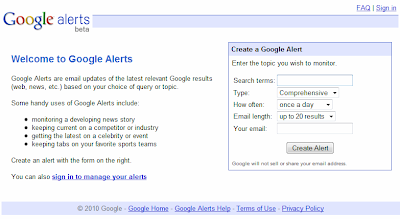
What Alerts Should Authors Have?
I recommend authors set up alerts for their author or pen name(s), the titles of each of their books, the name(s) of their blog(s) and/or website(s), and the names of any events, sites, etc. with which the author is affiliated. I also recommend the following settings for Alerts:
Type: Comprehensive - so you don't miss any mentions
How Often: once a day or once a week - so you're not inundated with Alert emails
Email Length: up to 20 results - this limit will probably far exceed the actual number of results in your Alerts for a very long time
Author Workshop Cruise
my Alert would include any references to "Author", "Workshop", or "Cruise". If I enter the search term like this:
"Author Workshop Cruise"
my Alert will only include references to the entire phrase, "Author Workshop Cruise".
Alerts based on general search terms will return a lot of false positives even when you employ quotation marks, but it can't be helped in some cases. For example, I've set up an Alert for ' "Snow Ball" + novel ' to be notified anytime my novel Snow Ball is being bandied about online, but I also get a lot of hits from people who are talking about about actual balls of snow. Still, I'd rather scan through a few false positives each day than stay in the dark about it when people are talking about my book.
Only people with Google/Gmail accounts can make changes to their existing Alerts, and this is accomplished via the "Manage Alerts" link in any alert email. Users without Google/Gmail accounts can only delete existing Alerts and add new ones. If you don't have a Google/Gmail account and you need to change one of your Alerts, here's how to do it:
1. Copy down the parameters of the Alert from within one of its Alert emails, and mark the email with a star or file it in a location where you can easily locate it later
2. Go to the Google Alerts page and create a new Alert, using as many of the parameters you copied as you wish, and changing any you need to change
3. After you've received an Alert from the newly-created version (so you know it's working), return to the Alert email from which you copied the parameters, and click the "Delete this alert" link
How To React To An Alert
When an Alert notifies you of a positive mention, go to the site and see if comments are enabled. If they are, leave a note of thanks to the post's author, along with any additional remarks you can offer about the article, discussion topic, or post in question. Be sure to check off the "be notified of any responses" box, if there is one, so if anyone replies to your comment you'll be notified and can come back to respond. Also be sure to spread the word by sharing a link to the page whenever appropriate. This is a win-win that rewards the person who mentioned you or your work by driving traffic to their site, and strengthens your author platform by demonstrating that people are saying nice things about you or your work.
You will be amazed at what a big impact your response and publicity can have on the people who've mentioned you or your work. They will feel validated and appreciated, and will be that much more likely to sing your praises whenever the opportunity arises.
When an Alert notifies you of a negative mention, you'll need to decide whether or not it will be productive for you to respond. In most cases, it isn't. Please see these posts for additional guidance:
Congratulations, You Get To Be The Bigger Person Now
Internet Defamation, Author Platform, And You
So head on over to Google Alerts and get your personal tattle-tale on the job right away!
How To Use Google Alerts
The way it works is simple: you go to the Google Alerts page and set up a separate Alert for each word or phrase you'd like reported back to you. Note that you don't have to have a Google or Gmail account to do this.

Under "Type" you can specify whether you want the Alert to search News (news reporting sites), Blogs, Web (non-blog websites), Video (video sharing sites like YouTube), Groups (online communities), or Comprehensive (any mention on any site). Under "How often" you can tell Google Alerts to notify you as-it-happens, once a day or once a week. Anytime the word or phrase you've specified turns up online, Google Alerts sends you an email with a link to the page where the mention occurred. For "Email length" you can choose an upper limit of 20 results or 50 results per email notification. Then you just enter your email address, click the Create Alert button, and your personal tattle-tale is on the job.
What Alerts Should Authors Have?
I recommend authors set up alerts for their author or pen name(s), the titles of each of their books, the name(s) of their blog(s) and/or website(s), and the names of any events, sites, etc. with which the author is affiliated. I also recommend the following settings for Alerts:
Type: Comprehensive - so you don't miss any mentions
How Often: once a day or once a week - so you're not inundated with Alert emails
Email Length: up to 20 results - this limit will probably far exceed the actual number of results in your Alerts for a very long time
Be sure to enter your Alert search terms the same as you would in a search engine. Use quotation marks around phrases and full names to avoid a lot of incorrect results. For example, if I entered the Alert search for Publetariat's Author Workshop Cruise like this:
Author Workshop Cruise
my Alert would include any references to "Author", "Workshop", or "Cruise". If I enter the search term like this:
"Author Workshop Cruise"
my Alert will only include references to the entire phrase, "Author Workshop Cruise".
Alerts based on general search terms will return a lot of false positives even when you employ quotation marks, but it can't be helped in some cases. For example, I've set up an Alert for ' "Snow Ball" + novel ' to be notified anytime my novel Snow Ball is being bandied about online, but I also get a lot of hits from people who are talking about about actual balls of snow. Still, I'd rather scan through a few false positives each day than stay in the dark about it when people are talking about my book.
Only people with Google/Gmail accounts can make changes to their existing Alerts, and this is accomplished via the "Manage Alerts" link in any alert email. Users without Google/Gmail accounts can only delete existing Alerts and add new ones. If you don't have a Google/Gmail account and you need to change one of your Alerts, here's how to do it:
1. Copy down the parameters of the Alert from within one of its Alert emails, and mark the email with a star or file it in a location where you can easily locate it later
2. Go to the Google Alerts page and create a new Alert, using as many of the parameters you copied as you wish, and changing any you need to change
3. After you've received an Alert from the newly-created version (so you know it's working), return to the Alert email from which you copied the parameters, and click the "Delete this alert" link
How To React To An Alert
When an Alert notifies you of a positive mention, go to the site and see if comments are enabled. If they are, leave a note of thanks to the post's author, along with any additional remarks you can offer about the article, discussion topic, or post in question. Be sure to check off the "be notified of any responses" box, if there is one, so if anyone replies to your comment you'll be notified and can come back to respond. Also be sure to spread the word by sharing a link to the page whenever appropriate. This is a win-win that rewards the person who mentioned you or your work by driving traffic to their site, and strengthens your author platform by demonstrating that people are saying nice things about you or your work.
You will be amazed at what a big impact your response and publicity can have on the people who've mentioned you or your work. They will feel validated and appreciated, and will be that much more likely to sing your praises whenever the opportunity arises.
When an Alert notifies you of a negative mention, you'll need to decide whether or not it will be productive for you to respond. In most cases, it isn't. Please see these posts for additional guidance:
Congratulations, You Get To Be The Bigger Person Now
Internet Defamation, Author Platform, And You
So head on over to Google Alerts and get your personal tattle-tale on the job right away!
Wednesday, January 20, 2010
Congratulations: You Get To Be The Bigger Person Now
If you’re working your author platform effectively, you’re very active online. You’re doing any or all of the following: posting to your blog, possibly posting to others’ blogs, tweeting, posting updates on Facebook or MySpace or LinkedIn, participating in online discussion groups and comment threads, posting or commenting on YouTube book trailers, and maybe even podcasting. Your goal is to open a dialogue with readers and your peers, and the better your author platform, the more feedback and discussion you will generate. Much of the feedback and discussion will be enjoyable and thought-provoking, a kind of online ‘salon’. The rest of it, not so much.
An awful lot of people will have strongly held opinions with which you disagree, or which are ill-informed, or which are obviously being shared only for the sake of getting a rise out of you or casting aspersions on you or your work. But however much you may want to angrily tear into this latter group anytime they darken your virtual doorstep, however tempting it may be to respond with a biting and clever remark, you must never do it. Answering the uncouth and trollish in kind requires you to become uncouth and trollish, which can quickly escalate beyond your control, undermine all the goodwill you’ve built up to date with your community of readers and peers, and quickly turn off any newcomers to your tribe. As an author, you’ll find there are two primary arenas in which you may feel tempted to rain invective upon a perceived adversary: following a bad review, or following an ill-informed or insulting post to, or about, you. First, let’s look at what happens when authors respond to negative reviews…negatively.
Consider this case of commercially- and critically-successful novelist Alice Hoffman, who was so outraged by a negative review (some have called it merely lukewarm) from author Roberta Silman in the Boston Globe that Hoffman ended up flaming Silman all over Twitter. Hoffman eventually went so far as to provide Silman’s phone number to her fans and request that they call Silman to defend Hoffman. It wasn’t long before the mainstream press was all over this, and not much longer before an embarrassed Hoffman began making public apologies.
Then there’s author Alain de Botton, who responded to a negative review on Caleb Crain’s blog with a number of posts that eventually escalated to the point where Botton was saying things like, “I will hate you till the day I die and wish you nothing but ill will in every career move you make.” There’s a terrific post about the incident on Ed Rants in which de Botton responds to questions about the incident and provides an essay as part of his response as well.
Next, take a gander at the controversy more recently sparked by author Candace Sams on Amazon. When reader-reviewer LB Taylor posted a one-star review of Sam’s novel Electra Galaxy's Mr Interstellar Feller, Sams responded with a series of angry responses, initially under an alias but eventually under her own name as well. When the dust had settled and the press and blogs were finished with her Sams went back and deleted all of her posts in the Amazon thread, but it was too late by then because plenty of sites and blogs (such as Babbling About Books) had already copied and re-published the worst of them online.
Prior to the Sams debacle, perhaps the best-known author outburst came from Anne Rice in 2004, also on Amazon, in response to multiple negative reviews of her novel, Blood Canticle. In a 1200-word diatribe, among other things, Rice responded to reader-critics by saying, “Your stupid, arrogant assumptions about me and what I am doing are slander…You have used the site as if it were a public urinal to publish falsehood and lies." Her entire response is reprinted on the encyclopedia dramatica site, where the term “rice out” is defined as, “To make a spectacle of oneself in response to literary criticism by insisting that one's creative work is superior in all aspects.”
Now, compare these authorial meltdowns to the actions of Carla Cassidy, who posted a wry and clever rebuttal to a negative review on the Smart Bitches, Trashy Books site. SBTB’s review featured a sarcastic, snarky list of 26 reasons why Cassidy’s novel Pregnesia is the best book in the history of pregnant amnesiac romance books. Cassidy responded with her own list of 10 reasons why she loves the SBTB review, as detailed on the Saturday Writers site. According to Saturday Writers, “Carla responded with grace and humor that exactly matched the tone of the review. I don’t think I could respond so well to a negative review. I’m in awe of her.”
If you can’t craft a humorous and/or graceful response to a negative review—and the many examples of non-humorous, non-graceful responses from seasoned authors given in this post are proof enough that you can’t trust your own judgment on this—, then it’s best just to keep your mouth (and keyboard) shut entirely on such matters. As Neil Gaiman has said on his blog, “some things are better written in anger and deleted in the morning.”
As for coping with stuff and nonsense from respondents to articles or blog posts you’ve written, or from people who are more or less just out to make you look bad, you should simply ignore such commentary when it’s clearly labeled as opinion but it may sometimes be necessary to correct inaccurate factual information posted about you or your work. If you choose to do so you must tread with the utmost care, lest a new idiom for author freak-outs turns up in common usage with your name attached to it. I don’t think I’ve yet seen a more shining example of calm, professional, classy damage control than that of Harlequin Digital Director Malle Valik in response to the firestorm of controversy that followed Harlequin’s announcement of its partnership with Author Solutions, Inc.
First, Malle responded personally to the many charges leveled against the partnership on Smart Bitches, Trashy Books (scroll down through the comments thread to Malle’s first comment, posted on 11/18/09 at 6:48am). Next, she graciously answered some specific questions about the deal on Dear Author, then came back to respond to some very pointed and angry remarks in the comments thread following that interview. In the face of a plethora of insults and accusations, Malle kept her cool, kept a positive attitude, and remained professional. She kept the discussion on-point, and never allowed herself to stoop to the mud-slinging tone employed by many of the attackers.
Malle Valik is to be commended for her exemplary performance in this matter, and to be emulated by every one of us anytime we find ourselves in the unenviable shoes she was wearing last November. To do so, you must first acknowledge that as a writer, you are in the free speech business. It is your duty (and should be your honor) to defend the right of anyone to voice any opinion on any subject, however much you may disagree with that opinion or even find it offensive. While I freely acknowledge that very often, the people who put you in a mind to take the low road are not honestly attempting to engage you in a fair debate, it will do you no good to respond to them in kind. Correct factual errors if you must, but only if you’re certain you’re capable of Valikian conduct in the matter. Take action on libelous statements about you or your work if you feel they have the potential to do significant damage to your earnings or reputation, but do so in private, offline. Otherwise, your safest bet is to ignore the noise; it’s not truly worthy of your attention, anyway.
An awful lot of people will have strongly held opinions with which you disagree, or which are ill-informed, or which are obviously being shared only for the sake of getting a rise out of you or casting aspersions on you or your work. But however much you may want to angrily tear into this latter group anytime they darken your virtual doorstep, however tempting it may be to respond with a biting and clever remark, you must never do it. Answering the uncouth and trollish in kind requires you to become uncouth and trollish, which can quickly escalate beyond your control, undermine all the goodwill you’ve built up to date with your community of readers and peers, and quickly turn off any newcomers to your tribe. As an author, you’ll find there are two primary arenas in which you may feel tempted to rain invective upon a perceived adversary: following a bad review, or following an ill-informed or insulting post to, or about, you. First, let’s look at what happens when authors respond to negative reviews…negatively.
Consider this case of commercially- and critically-successful novelist Alice Hoffman, who was so outraged by a negative review (some have called it merely lukewarm) from author Roberta Silman in the Boston Globe that Hoffman ended up flaming Silman all over Twitter. Hoffman eventually went so far as to provide Silman’s phone number to her fans and request that they call Silman to defend Hoffman. It wasn’t long before the mainstream press was all over this, and not much longer before an embarrassed Hoffman began making public apologies.
Then there’s author Alain de Botton, who responded to a negative review on Caleb Crain’s blog with a number of posts that eventually escalated to the point where Botton was saying things like, “I will hate you till the day I die and wish you nothing but ill will in every career move you make.” There’s a terrific post about the incident on Ed Rants in which de Botton responds to questions about the incident and provides an essay as part of his response as well.
Next, take a gander at the controversy more recently sparked by author Candace Sams on Amazon. When reader-reviewer LB Taylor posted a one-star review of Sam’s novel Electra Galaxy's Mr Interstellar Feller, Sams responded with a series of angry responses, initially under an alias but eventually under her own name as well. When the dust had settled and the press and blogs were finished with her Sams went back and deleted all of her posts in the Amazon thread, but it was too late by then because plenty of sites and blogs (such as Babbling About Books) had already copied and re-published the worst of them online.
Prior to the Sams debacle, perhaps the best-known author outburst came from Anne Rice in 2004, also on Amazon, in response to multiple negative reviews of her novel, Blood Canticle. In a 1200-word diatribe, among other things, Rice responded to reader-critics by saying, “Your stupid, arrogant assumptions about me and what I am doing are slander…You have used the site as if it were a public urinal to publish falsehood and lies." Her entire response is reprinted on the encyclopedia dramatica site, where the term “rice out” is defined as, “To make a spectacle of oneself in response to literary criticism by insisting that one's creative work is superior in all aspects.”
Now, compare these authorial meltdowns to the actions of Carla Cassidy, who posted a wry and clever rebuttal to a negative review on the Smart Bitches, Trashy Books site. SBTB’s review featured a sarcastic, snarky list of 26 reasons why Cassidy’s novel Pregnesia is the best book in the history of pregnant amnesiac romance books. Cassidy responded with her own list of 10 reasons why she loves the SBTB review, as detailed on the Saturday Writers site. According to Saturday Writers, “Carla responded with grace and humor that exactly matched the tone of the review. I don’t think I could respond so well to a negative review. I’m in awe of her.”
If you can’t craft a humorous and/or graceful response to a negative review—and the many examples of non-humorous, non-graceful responses from seasoned authors given in this post are proof enough that you can’t trust your own judgment on this—, then it’s best just to keep your mouth (and keyboard) shut entirely on such matters. As Neil Gaiman has said on his blog, “some things are better written in anger and deleted in the morning.”
As for coping with stuff and nonsense from respondents to articles or blog posts you’ve written, or from people who are more or less just out to make you look bad, you should simply ignore such commentary when it’s clearly labeled as opinion but it may sometimes be necessary to correct inaccurate factual information posted about you or your work. If you choose to do so you must tread with the utmost care, lest a new idiom for author freak-outs turns up in common usage with your name attached to it. I don’t think I’ve yet seen a more shining example of calm, professional, classy damage control than that of Harlequin Digital Director Malle Valik in response to the firestorm of controversy that followed Harlequin’s announcement of its partnership with Author Solutions, Inc.
First, Malle responded personally to the many charges leveled against the partnership on Smart Bitches, Trashy Books (scroll down through the comments thread to Malle’s first comment, posted on 11/18/09 at 6:48am). Next, she graciously answered some specific questions about the deal on Dear Author, then came back to respond to some very pointed and angry remarks in the comments thread following that interview. In the face of a plethora of insults and accusations, Malle kept her cool, kept a positive attitude, and remained professional. She kept the discussion on-point, and never allowed herself to stoop to the mud-slinging tone employed by many of the attackers.
Malle Valik is to be commended for her exemplary performance in this matter, and to be emulated by every one of us anytime we find ourselves in the unenviable shoes she was wearing last November. To do so, you must first acknowledge that as a writer, you are in the free speech business. It is your duty (and should be your honor) to defend the right of anyone to voice any opinion on any subject, however much you may disagree with that opinion or even find it offensive. While I freely acknowledge that very often, the people who put you in a mind to take the low road are not honestly attempting to engage you in a fair debate, it will do you no good to respond to them in kind. Correct factual errors if you must, but only if you’re certain you’re capable of Valikian conduct in the matter. Take action on libelous statements about you or your work if you feel they have the potential to do significant damage to your earnings or reputation, but do so in private, offline. Otherwise, your safest bet is to ignore the noise; it’s not truly worthy of your attention, anyway.
Friday, November 6, 2009
How Conferences And Other Writers’ Events Can Strengthen Your Author Platform
If you’re budget-minded (like me), you probably think of writers’ or publishers’ conferences as a luxury: something you know you can benefit from, and something you’d love to do more often, but something for which it can be hard to justify the expense. Well, in addition to the educational and social networking benefits, it turns out there can be major author platform dividends as well.
Author Christina Katz (a.k.a.The Writermama) had two books published and a sizable readership when she was invited by O’Reilly Media to blog at the 2009 O’Reilly Tools of Change (TOC) conference. Katz was already known to a readership of writers but she was not a big name in publishing circles. While at the conference, Katz noticed other attendees Tweeting and decided to use Twitter to share her impressions of the conference rather than blogging. She sent frequent missives from each session she attended to provide her Twitter followers with real-time reportage.
Within a couple of hours the word was out on the ‘net: everyone who wanted to know what was going on at TOC was following Katz’ tweets. Her number of followers spiked over the course of the conference from about 400 to over 1,000, about the number of people attending the conference. In only a matter of hours, other folks tweeting the conference were soon wondering, “Who is The Writermama?” (@thewritermama is Katz’ Twitter username — she’d neglected to add her real name to her Twitter profile).
Ron Hogan from MediaBistro approached Katz when he saw her tweeting in the same session and asked if she was the mysterious tweeter everyone was wondering about. Attendees and presenters alike were soon following Katz’ tweets. Attendees thanking her for her updates from sessions they’d missed. Presenters thanking her for reporting on their sessions.
Meanwhile, away from the conference, hundreds of authors, publishing staffers and others who were following Christina’s tweets could easily discover more about her by checking out her sites, blogs and books online. Thanks to her presence at the conference, Christina’s brand recognition, industry reputation, and reach grew by leaps and bounds that weekend.
Tweet It
Now that tweeting from events is commonplace, if you intend to use the same strategy you’ll need to tweet both in quality and quantity to rise to the top of the Twittering crowd. But that’s not the only way to use conference and event attendance to grow your author platform.
Blog About It
If any part of the target demographic for your books are peers, do them a solid and share the experience. Remember that you’re present at an event most of your peers cannot attend, but a great many of them wish they could be there. You’re in a position to provide some inside information on what the event was like, and a highlights reel of information from the sessions and workshops you attended. Take careful notes on every talk, and you can have blog fodder lined up for many posts to come.
If the intended audience for your books and websites is composed primarily of reader-consumers, there are still some blogging gold nuggets to be mined from event attendance. You went to the event expecting to get something out of it as an author. Blog about the impact your experiences will have on your work, or on you as an author. If you were inspired, who or what inspired you, and why? Conversely, if you were disappointed or frustrated, blog about that.
Make Connections
Take advantage of breaks between sessions to mix and mingle with your fellow attendees and session presenters. If there’s an onsite lunch option, take it. You can bet that most presenters will remain onsite for lunch, and people you’d consider to be VIPs are much more accessible and approachable in an event setting. If there are any evening mixers or tweetups in the offing, attend those as well. They provide a terrific opportunity to meet attendees and presenters in a casual setting where everyone’s more comfortable chatting and having fun.
I’m not suggesting that you pitch your book ideas to the people you meet onsite, however. If you’re only chatting with Bob Agent because you’re looking for an opening to lob him a query, that will be all too apparent—and very annoying to Bob. Just focus on planting some relationship seeds and making a positive impression. If you can do that, Bob Agent is much more likely to be receptive to your query after the event.
Have some business cards printed up ahead of time (you can even print a small quantity yourself at home using special business-card paper stock, available at office supply stores), and exchange cards with others every time the opportunity presents itself. Make some brief notes about the people you meet on the back of their cards, and when you get back home you’ll have an insta-rolodex of event-related contacts to whom you can turn in the future when you have questions or ideas that may be of interest to those you’ve met. Unless you’ve really bonded on a personal level with a given individual however, be cautious in the tenor and frequency of your communications after the event. You want to become a trusted contact, not a pest.
Be A Speaker
Most big conferences put out a call for session and workshop proposals a year or so in advance of the event. If you’re comfortable with public speaking and have some relevant experience or skills, don’t be afraid to submit proposals. While conference organizers for a self-publishing event aimed at aspiring authors might not be terribly interested in the content of your book or your approach to craft, if you’ve become a social media whiz or expert in ebook production while working your platform, they very well may be.
Many conference sessions take the form of discussion panels, with a moderator asking questions of multiple speakers. If you are ever invited to be part of such a panel at a high-profile event, DO IT. Even if you have to pay your own travel expenses, if there’s any way you can swing it, DO SO. You’ll get invaluable exposure that can raise your profile exponentially. Being able to add that speaking credit to your credentials (and list it on your website) elevates your legitimacy within the industry while simultaneously establishing or reinforcing your stature as a subject area expert. On top of all that, it will also make it easier for you to book future speaking engagements. Hopefully, at least some of those will cover your travel expenses or even pay you a speaking fee. And if you’re paying your own way, here in the U.S. expenses related to the event are tax-deductible (so long as you report your authorship-related income and expenses on your taxes; consult a tax professional for further information).
If you've been doing a good job of making connections at previous events, you may even be able to pull together your own panel of experts to propose a panel talk at which you will act as moderator.
When Smashwords founder Mark Coker invited me to participate in a speaker panel at TOC 2009, my initial reaction was to thank him for thinking of me, but decline. I’d have to pay all my own expenses, and the trip from Los Angeles to New York is not cheap. Neither are New York hotels. Or meals. Or taxi cabs. But upon further consideration I decided the exposure would be worth the expense, and I was right. Speaking at that event gave me name recognition in the publishing industry, opened the door to more speaking opportunities, allowed me to make some invaluable contacts and conferred a great
deal of legitimacy upon me and my message.
So you see, attending TOC, PubWest, DigiBookWorld, the Author Workshop Cruise or similar events is no mere luxury. Strive to make your participation in such events a plank in your author platform whenever possible. The more active you are in the larger community of writers and publishing, the easier it will be to build, maintain and grow your platform.
Author Christina Katz (a.k.a.The Writermama) had two books published and a sizable readership when she was invited by O’Reilly Media to blog at the 2009 O’Reilly Tools of Change (TOC) conference. Katz was already known to a readership of writers but she was not a big name in publishing circles. While at the conference, Katz noticed other attendees Tweeting and decided to use Twitter to share her impressions of the conference rather than blogging. She sent frequent missives from each session she attended to provide her Twitter followers with real-time reportage.
Within a couple of hours the word was out on the ‘net: everyone who wanted to know what was going on at TOC was following Katz’ tweets. Her number of followers spiked over the course of the conference from about 400 to over 1,000, about the number of people attending the conference. In only a matter of hours, other folks tweeting the conference were soon wondering, “Who is The Writermama?” (@thewritermama is Katz’ Twitter username — she’d neglected to add her real name to her Twitter profile).
Ron Hogan from MediaBistro approached Katz when he saw her tweeting in the same session and asked if she was the mysterious tweeter everyone was wondering about. Attendees and presenters alike were soon following Katz’ tweets. Attendees thanking her for her updates from sessions they’d missed. Presenters thanking her for reporting on their sessions.
Meanwhile, away from the conference, hundreds of authors, publishing staffers and others who were following Christina’s tweets could easily discover more about her by checking out her sites, blogs and books online. Thanks to her presence at the conference, Christina’s brand recognition, industry reputation, and reach grew by leaps and bounds that weekend.
Tweet It
Now that tweeting from events is commonplace, if you intend to use the same strategy you’ll need to tweet both in quality and quantity to rise to the top of the Twittering crowd. But that’s not the only way to use conference and event attendance to grow your author platform.
Blog About It
If any part of the target demographic for your books are peers, do them a solid and share the experience. Remember that you’re present at an event most of your peers cannot attend, but a great many of them wish they could be there. You’re in a position to provide some inside information on what the event was like, and a highlights reel of information from the sessions and workshops you attended. Take careful notes on every talk, and you can have blog fodder lined up for many posts to come.
If the intended audience for your books and websites is composed primarily of reader-consumers, there are still some blogging gold nuggets to be mined from event attendance. You went to the event expecting to get something out of it as an author. Blog about the impact your experiences will have on your work, or on you as an author. If you were inspired, who or what inspired you, and why? Conversely, if you were disappointed or frustrated, blog about that.
Make Connections
Take advantage of breaks between sessions to mix and mingle with your fellow attendees and session presenters. If there’s an onsite lunch option, take it. You can bet that most presenters will remain onsite for lunch, and people you’d consider to be VIPs are much more accessible and approachable in an event setting. If there are any evening mixers or tweetups in the offing, attend those as well. They provide a terrific opportunity to meet attendees and presenters in a casual setting where everyone’s more comfortable chatting and having fun.
I’m not suggesting that you pitch your book ideas to the people you meet onsite, however. If you’re only chatting with Bob Agent because you’re looking for an opening to lob him a query, that will be all too apparent—and very annoying to Bob. Just focus on planting some relationship seeds and making a positive impression. If you can do that, Bob Agent is much more likely to be receptive to your query after the event.
Have some business cards printed up ahead of time (you can even print a small quantity yourself at home using special business-card paper stock, available at office supply stores), and exchange cards with others every time the opportunity presents itself. Make some brief notes about the people you meet on the back of their cards, and when you get back home you’ll have an insta-rolodex of event-related contacts to whom you can turn in the future when you have questions or ideas that may be of interest to those you’ve met. Unless you’ve really bonded on a personal level with a given individual however, be cautious in the tenor and frequency of your communications after the event. You want to become a trusted contact, not a pest.
Be A Speaker
Most big conferences put out a call for session and workshop proposals a year or so in advance of the event. If you’re comfortable with public speaking and have some relevant experience or skills, don’t be afraid to submit proposals. While conference organizers for a self-publishing event aimed at aspiring authors might not be terribly interested in the content of your book or your approach to craft, if you’ve become a social media whiz or expert in ebook production while working your platform, they very well may be.
Many conference sessions take the form of discussion panels, with a moderator asking questions of multiple speakers. If you are ever invited to be part of such a panel at a high-profile event, DO IT. Even if you have to pay your own travel expenses, if there’s any way you can swing it, DO SO. You’ll get invaluable exposure that can raise your profile exponentially. Being able to add that speaking credit to your credentials (and list it on your website) elevates your legitimacy within the industry while simultaneously establishing or reinforcing your stature as a subject area expert. On top of all that, it will also make it easier for you to book future speaking engagements. Hopefully, at least some of those will cover your travel expenses or even pay you a speaking fee. And if you’re paying your own way, here in the U.S. expenses related to the event are tax-deductible (so long as you report your authorship-related income and expenses on your taxes; consult a tax professional for further information).
If you've been doing a good job of making connections at previous events, you may even be able to pull together your own panel of experts to propose a panel talk at which you will act as moderator.
When Smashwords founder Mark Coker invited me to participate in a speaker panel at TOC 2009, my initial reaction was to thank him for thinking of me, but decline. I’d have to pay all my own expenses, and the trip from Los Angeles to New York is not cheap. Neither are New York hotels. Or meals. Or taxi cabs. But upon further consideration I decided the exposure would be worth the expense, and I was right. Speaking at that event gave me name recognition in the publishing industry, opened the door to more speaking opportunities, allowed me to make some invaluable contacts and conferred a great
deal of legitimacy upon me and my message.
Use The Right Hashtag
When you post anything online about the event, whether it’s tweets, Facebook updates, blog posts or articles, be sure to include the appropriate hashtag for the event in the body of your content as well as in the “tags” section in the case of blog posts or articles. Doing so will make your content turn up in searches on that hashtag, as well as in searches for online content related to the event. Event organizers will often post their preferred hashtag right on the event site. If not, you can do a Google search on the event to identify the hashtag used most frequently by others, then use that same hashtag in your tweets, updates and posts.
So you see, attending TOC, PubWest, DigiBookWorld, the Author Workshop Cruise or similar events is no mere luxury. Strive to make your participation in such events a plank in your author platform whenever possible. The more active you are in the larger community of writers and publishing, the easier it will be to build, maintain and grow your platform.
Thursday, October 15, 2009
Tune In For #Platformchat & Get Your Questions Answered!
Christina Katz, The Writer Mama and author of Get Known Before the Book Deal, hosts a regular Twitter interview series known as #Platformchat, and I and author Seth Harwood will be guests on Friday, 10/23. From Christina's site:
On Friday, October 23rd our #platformchat guests will be Seth Harwood & April Hamilton. Time is: 11:00 - noon PT (noon - 1:00 MT, 1:00 - 2:00 CT, & 2:00 - 3:00 ET).
Topic: Common sense podcasting & self-publishing strategies
Anyone with a Twitter account can participate. I recommend using Tweetchat.com and plugging in our hashtag, #platformchat, to follow and participate in the chat. Once you have a Twitter account, you can use your Twitter ID and password to get a Tweetchat account very quickly. I hope you will bring your questions on this topic and join the discussion!
Please note: #platformchat is monthly now. Stay tuned to this blog for updates. Thanks!
Here's a little more about our guests:
 Seth Harwood (@SethHarwood) graduated from the Iowa Writers’ Workshop and can be found online at SethHarwood.com, where his podcasts of Jack Wakes Up and its sequels have drawn a devoted following. Jack Wakes Up debuted May 5th from Three Rivers Press (Random House) and is currently available everywhere books are sold. He lives in Berkeley, with his wife, Joelle, and teaches at Stanford University and the City College of San Francisco.
 April L. Hamilton (@indieauthor) is an author, blogger, Technorati BlogCritic, leading advocate and speaker for the indie author movement, and founder and Editor in Chief of Publetariat, the premier online news hub and community for indie authors and small imprints. She's a frequent conference speaker on subjects related to self-publishing, and judge for self-published book competitions. In her popular self-published reference book, The IndieAuthor Guide, she offers aspiring self-published authors a roadmap to success. She is also the author of novels available in both ebook and POD form.
#platformchat moderators are:
 Christina Katz is the author of Get Known Before the Book Deal, Use Your Personal Strengths to Build an Author Platform and Writer Mama, How to Raise a Writing Career Alongside Your Kids (both for Writer’s Digest Books). A platform development coach and consultant, she teaches writing career development, hosts the Northwest Author Series, and is the publisher of several e-zines including Writers on the Rise. Christina blogs at The Writer Mama Riffs and Get Known Before the Book Deal, and speaks at MFA programs, literary events, and conferences around the country. Follow Christina on Twitter at @thewritermama.

Meryl K. Evans is the author of Brilliant Outlook Pocketbook, co-author of Adapting to Web Standards: CSS and Ajax for Big Sites and contributor to many others. The long-time blogger and gamer has written and edited for a bunch of places online and off. A native Texan, she lives a heartbeat north of Dallas in Plano, Texas with her husband and three kiddos. Though born in silence, she tries to show that deaf people are just like everyone else. Follow Meryl on Twitter at @merylkevans.
If you missed our recent chats, you are welcome to peruse recent transcripts:
September11th #platformchat
August 7th #platformchat
July 24th #platformchat
July 14th #platformchat
June 26th #platformchat
I think this will be a great event, and I look forward to "tweeting" you there!
On Friday, October 23rd our #platformchat guests will be Seth Harwood & April Hamilton. Time is: 11:00 - noon PT (noon - 1:00 MT, 1:00 - 2:00 CT, & 2:00 - 3:00 ET).
Topic: Common sense podcasting & self-publishing strategies
Anyone with a Twitter account can participate. I recommend using Tweetchat.com and plugging in our hashtag, #platformchat, to follow and participate in the chat. Once you have a Twitter account, you can use your Twitter ID and password to get a Tweetchat account very quickly. I hope you will bring your questions on this topic and join the discussion!
Please note: #platformchat is monthly now. Stay tuned to this blog for updates. Thanks!
Here's a little more about our guests:
Seth Harwood (@SethHarwood) graduated from the Iowa Writers’ Workshop and can be found online at SethHarwood.com, where his podcasts of Jack Wakes Up and its sequels have drawn a devoted following. Jack Wakes Up debuted May 5th from Three Rivers Press (Random House) and is currently available everywhere books are sold. He lives in Berkeley, with his wife, Joelle, and teaches at Stanford University and the City College of San Francisco.April L. Hamilton (@indieauthor) is an author, blogger, Technorati BlogCritic, leading advocate and speaker for the indie author movement, and founder and Editor in Chief of Publetariat, the premier online news hub and community for indie authors and small imprints. She's a frequent conference speaker on subjects related to self-publishing, and judge for self-published book competitions. In her popular self-published reference book, The IndieAuthor Guide, she offers aspiring self-published authors a roadmap to success. She is also the author of novels available in both ebook and POD form.#platformchat moderators are:
Christina Katz is the author of Get Known Before the Book Deal, Use Your Personal Strengths to Build an Author Platform and Writer Mama, How to Raise a Writing Career Alongside Your Kids (both for Writer’s Digest Books). A platform development coach and consultant, she teaches writing career development, hosts the Northwest Author Series, and is the publisher of several e-zines including Writers on the Rise. Christina blogs at The Writer Mama Riffs and Get Known Before the Book Deal, and speaks at MFA programs, literary events, and conferences around the country. Follow Christina on Twitter at @thewritermama.Meryl K. Evans is the author of Brilliant Outlook Pocketbook, co-author of Adapting to Web Standards: CSS and Ajax for Big Sites and contributor to many others. The long-time blogger and gamer has written and edited for a bunch of places online and off. A native Texan, she lives a heartbeat north of Dallas in Plano, Texas with her husband and three kiddos. Though born in silence, she tries to show that deaf people are just like everyone else. Follow Meryl on Twitter at @merylkevans.
If you missed our recent chats, you are welcome to peruse recent transcripts:
September11th #platformchat
August 7th #platformchat
July 24th #platformchat
July 14th #platformchat
June 26th #platformchat
I think this will be a great event, and I look forward to "tweeting" you there!
Thursday, October 8, 2009
Don’t Be Part of the 5%: Master The 5 Crucial Author Platform Skills
For the past several months, I’ve been working on the Publetariat Vault. Among the hundreds of authors who’ve registered for Vault membership, about 5% are completely overwhelmed by the listing form. They refuse to read or follow the instructions on the form, or think 17 required fields are too much to ask, or don’t know how to create a synopsis or excerpt in pdf, rtf or txt format, or don’t know how to upload files to the site using the typical “Browse” + “Upload” button combo. And they’re kind of pissed off that we’re asking them to do all of this in the first place, they’re walking away from up to 5 months’ free listing time on account of tech frustration. A couple of years ago I would’ve said the 5% are absolutely right, such a form is too demanding and no author should be expected to have that level of tech savvy. But the bar has been raised, and nowadays any author with a strong platform has all the skills necessary to easily complete the Vault form. The rest can no longer afford to be part of the 5%. It's not fair, and it has nothing to do with quality writing, but it is the reality.
Any author who’s not yet heard the term “author platform” could only have been lost at sea or living in Amish country, but even among those who know it, I’m finding the term is often not fully understood. Many authors, both aspiring and published, indie and mainstream, think succeeding with author platform means having a blog or author website. And maybe they Twitter a little, or have a Facebook or MySpace page. They also often think author platform is something that’s very difficult and/or expensive, and only applicable to published authors.
They are wrong, on all counts.
Author platform encompasses everything you do both to promote your work and to establish yourself as a “brand” in the marketplace, and ideally, it begins long before you have a book to sell. Even if you intend to go the totally mainstream route of writing the best damned manuscript you can and then querying agents and publishers, you can no longer expect to get a pass on author platform. I’m currently working with Writers Digest on the publication of a revised and updated edition of my book, The IndieAuthor Guide, and when our talks began the very first questions they had for me were all about my author platform. What websites do I have, and how much traffic do they get? How many pageviews, how many unique visitors? How frequently do I blog? How frequently do I have public speaking engagements, and where and for whom have I done such engagements? Do I maintain an email newsletter or membership list, and if so, how large is it?
If you’re lucky enough to get a request for the full manuscript from an agent or publisher, are you prepared to answer all these questions? Because if you’re not, you’re not ready to have your full ms requested. And if you’re intending to self-publish, you should be asking these questions of yourself already.
Lucky for all of us, the minimum skills needed to do a pretty decent job with online author platform are few, and easy to master. The way it works is, with each new skill you acquire, new online promotion and publication options are opened to you. And when it comes to author platform, you want every available option at your disposal.
You must know how to use webforms to comment on articles or blog posts online, create and maintain your own blog, create and maintain a fill-in-the-blanks sort of author website, or have a Facebook or MySpace page.
If you also want to provide an online cover image of your book, or an author photo, you must either know how to create digital images (pictures a computer can read because they’re stored as a computer file; if you use a digital camera and know how to get the pictures off your camera and onto your computer, you already know how to create digital images) or have the images supplied by someone who does know how to create them, you must know how to use a graphics editor program to resize the images as needed to meet the file size and dimension requirements of the various sites on which you intend to share them, and you must know how upload files to a web server using a “Browse” + “Upload” button combo.
All the skills mentioned thus far are also needed to self-publish your work in hard copy formats via an online print service provider such as Createspace or Lulu, and to self-publish in various ebook formats via online ebook conversion services such as Smashwords or Scribd.
If you want to make excerpts of your work available for free viewing on your blog or website (which is one of the cheapest and most effective ways of growing readership), on top of everything else you must also know how to create an excerpt of the full work and output that excerpt to pdf format.
Let’s stop and take inventory. If you know how to use webforms, how to create and resize digital images, how to upload files to a web server and how to output your work in pdf format, you’ve got most of your self-publishing and online author platform options covered with just five basic tech skills. You can have a blog and a fill-in-the-blanks type of author website. You can comment on blogs and articles all over the ‘net. You can publish your work in multiple formats and make it available for sale online through various outlets. You can make excerpts of your work available online. You can Facebook, MySpace and LinkedIn to your heart’s content---and you can do all of these things for the cost of nothing more than your time and the price of a single author copy (in cases where you're self-pubbing in hard copy)! You'd be a fool to turn your back on such an embarrassment of author platform riches, but that's what the 5% do every day.
Now, if you also want to Twitter, you’ll want to bone up on web abbreviations, emoticons and hashtags. If you want to be able to add cool little widgets (e.g., hit counters, ‘my Goodreads bookshelf’, BookBuzzr, etc.) to your blog, author website, Facebook, MySpace or other online pages, you’ll need to be comfortable copying and pasting snippets of HTML or script code from the widget provider into the desired location, but even then, someone else is providing the code and all you’re doing is copying and pasting it the same as you’d do with any ordinary text. The best part is, most such widgets are available for free! If you don't know how to use them, you're missing a huge opportunity to jazz up your platform at no cost.
When you’re ready to graduate to the master class, you can learn about RSS syndication and how to set up a simple web form on your site or blog to allow your readers to subscribe to your email newsletter, but this is nothing you need to think about right away.
For now, just focus on mastering the 5 crucial author platform skills and get yourself out of that doomed 5%.
Addendum: Regarding the Vault form, I'm the first to admit it's a lengthy form. Authors will need to spend half an hour or so pulling together all the information they need to create a listing, and an additional 5-10 minutes to complete the form. However, the form includes very detailed instructions for every section and field, required fields are limited to those items publishers have said are most important in making acquisitions decisions, and authors participating in the Vault's current promotions are getting several months' free listing time. I'm sure those who go on to strike deals with publishers or producers will feel it was well worth filling out the form.
Any author who’s not yet heard the term “author platform” could only have been lost at sea or living in Amish country, but even among those who know it, I’m finding the term is often not fully understood. Many authors, both aspiring and published, indie and mainstream, think succeeding with author platform means having a blog or author website. And maybe they Twitter a little, or have a Facebook or MySpace page. They also often think author platform is something that’s very difficult and/or expensive, and only applicable to published authors.
They are wrong, on all counts.
Author platform encompasses everything you do both to promote your work and to establish yourself as a “brand” in the marketplace, and ideally, it begins long before you have a book to sell. Even if you intend to go the totally mainstream route of writing the best damned manuscript you can and then querying agents and publishers, you can no longer expect to get a pass on author platform. I’m currently working with Writers Digest on the publication of a revised and updated edition of my book, The IndieAuthor Guide, and when our talks began the very first questions they had for me were all about my author platform. What websites do I have, and how much traffic do they get? How many pageviews, how many unique visitors? How frequently do I blog? How frequently do I have public speaking engagements, and where and for whom have I done such engagements? Do I maintain an email newsletter or membership list, and if so, how large is it?
If you’re lucky enough to get a request for the full manuscript from an agent or publisher, are you prepared to answer all these questions? Because if you’re not, you’re not ready to have your full ms requested. And if you’re intending to self-publish, you should be asking these questions of yourself already.
Lucky for all of us, the minimum skills needed to do a pretty decent job with online author platform are few, and easy to master. The way it works is, with each new skill you acquire, new online promotion and publication options are opened to you. And when it comes to author platform, you want every available option at your disposal.
You must know how to use webforms to comment on articles or blog posts online, create and maintain your own blog, create and maintain a fill-in-the-blanks sort of author website, or have a Facebook or MySpace page.
If you also want to provide an online cover image of your book, or an author photo, you must either know how to create digital images (pictures a computer can read because they’re stored as a computer file; if you use a digital camera and know how to get the pictures off your camera and onto your computer, you already know how to create digital images) or have the images supplied by someone who does know how to create them, you must know how to use a graphics editor program to resize the images as needed to meet the file size and dimension requirements of the various sites on which you intend to share them, and you must know how upload files to a web server using a “Browse” + “Upload” button combo.
All the skills mentioned thus far are also needed to self-publish your work in hard copy formats via an online print service provider such as Createspace or Lulu, and to self-publish in various ebook formats via online ebook conversion services such as Smashwords or Scribd.
If you want to make excerpts of your work available for free viewing on your blog or website (which is one of the cheapest and most effective ways of growing readership), on top of everything else you must also know how to create an excerpt of the full work and output that excerpt to pdf format.
Let’s stop and take inventory. If you know how to use webforms, how to create and resize digital images, how to upload files to a web server and how to output your work in pdf format, you’ve got most of your self-publishing and online author platform options covered with just five basic tech skills. You can have a blog and a fill-in-the-blanks type of author website. You can comment on blogs and articles all over the ‘net. You can publish your work in multiple formats and make it available for sale online through various outlets. You can make excerpts of your work available online. You can Facebook, MySpace and LinkedIn to your heart’s content---and you can do all of these things for the cost of nothing more than your time and the price of a single author copy (in cases where you're self-pubbing in hard copy)! You'd be a fool to turn your back on such an embarrassment of author platform riches, but that's what the 5% do every day.
Now, if you also want to Twitter, you’ll want to bone up on web abbreviations, emoticons and hashtags. If you want to be able to add cool little widgets (e.g., hit counters, ‘my Goodreads bookshelf’, BookBuzzr, etc.) to your blog, author website, Facebook, MySpace or other online pages, you’ll need to be comfortable copying and pasting snippets of HTML or script code from the widget provider into the desired location, but even then, someone else is providing the code and all you’re doing is copying and pasting it the same as you’d do with any ordinary text. The best part is, most such widgets are available for free! If you don't know how to use them, you're missing a huge opportunity to jazz up your platform at no cost.
When you’re ready to graduate to the master class, you can learn about RSS syndication and how to set up a simple web form on your site or blog to allow your readers to subscribe to your email newsletter, but this is nothing you need to think about right away.
For now, just focus on mastering the 5 crucial author platform skills and get yourself out of that doomed 5%.
Addendum: Regarding the Vault form, I'm the first to admit it's a lengthy form. Authors will need to spend half an hour or so pulling together all the information they need to create a listing, and an additional 5-10 minutes to complete the form. However, the form includes very detailed instructions for every section and field, required fields are limited to those items publishers have said are most important in making acquisitions decisions, and authors participating in the Vault's current promotions are getting several months' free listing time. I'm sure those who go on to strike deals with publishers or producers will feel it was well worth filling out the form.
Thursday, October 1, 2009
Why Responsible Aggregation Is Not Only NOT Evil, But A GOOD Thing
There’s a lot of hue and cry against online aggregation circulating around the interwebs these days, and I really don’t get it.
Aggregator sites reprint excerpts from other sites’ articles and blog posts, along with a ‘keep reading’ or ‘read the rest’ link to the source article/blog post. The more responsible aggregators also include the name of the author, and the most considerate ones also include links to the author’s website or blog and a link to the home page of the site where the article or post originally appeared.
If an aggregator site prints an entire article or blog post, or 50% or greater of the article/post without the author’s permission, well that’s just theft. If the ‘read the rest’ link opens the source web page in a window controlled by the aggregator, that’s tantamount to theft since it appears to the viewer as if he or she hasn’t left the aggregator site; worse yet, most such windowing systems don’t make it easy for the viewer to escape from the aggregator’s window. They may click links on the source site, but the linked pages still open up in the aggregator’s window. As a web consumer, I find those aggregator windows incredibly annoying and have come to avoid following links provided by such aggregators.
If an aggregator fails to credit the author when printing an excerpt and ‘read the rest’ link, it’s depriving the author of his or her due and that’s wrong, too. If an aggregator surrounds aggregated material with lots of paid advertising, particularly advertising with which the authors of aggregated material might take issue, that’s also an abuse of the authors’ material. But if the excerpt is brief, the author is credited, a ‘read the rest’ link is provided back to the source article without wrapping it in the aggregator’s window, links are provided to the author’s website (where available) and the home page of the site where the aggregated material originally appeared, and advertising surrounding aggregated material is minimal and non-offensive, with very few exceptions (e.g., aggregation of material the author is offering for sale) I really don’t understand why authors or anyone else should have a problem with it.
Publetariat, a site I founded and for which I’m Editor in Chief, has a mix of both original and aggregated material. The site focuses on content for indie authors and small imprints, and operates on a ‘we scour the web for relevant articles so you don’t have to’ sort of paradigm while also providing a discussion board area and member profiles with blogging capability. Every weekday at about 11am PST, I tweet a link to the site with the titles of articles posted to the site for that day. My tweet is often retweeted by my Twitter followers, but I’ve noticed another phenomenon going on: some people retweet, but only after changing the link to point directly to the source article. They seem to be making a pointed, if somewhat passive, statement against Publetariat’s aggregation, but I don’t know why they feel the need to do so since Publetariat is providing a service to both the author and readers.
Publetariat is a heavily-trafficked and well-respected site in the publishing world, and it gets several thousand unique visitors every week. It also gets thousands of RSS feed hits every month. The site has a traffic rank in the top 2% of all sites worldwide, and a Technorati blog rank in the top .2%. In other words, getting your material on the front page of the Publetariat site gets you a LOT of exposure to a highly targeted audience of authors and publishers. Let’s look at a specific example.
My blog post entitled “Self-Publishing: Future Prerequisite” was published on my blog on 9/22/09 and cross-posted to the Publetariat site the same day. To date, the post on my blog has received 221 hits. Not too shabby. But the same post on Publetariat has received 709 hits: over three times as many reads. In the current climate, in which authors are supposed to be doing everything they can to attract readership and attention, why wouldn’t they want three times as many readers for their content? And if you’re an author services provider, such as an editor, book doctor or promotional consultant, why wouldn’t you want three times as many authors to know about you and your site?
To date, there have only been two authors/webmasters who’ve asked to have their aggregated material removed from the Publetariat site, and both times, Publetariat has complied with the request. But I will never understand why those authors/webmasters are turning down an opportunity for such highly-targeted, free exposure from a responsible aggregator.
When Publetariat aggregates, we credit the author, provide a ‘read the rest’ link that isn’t wrapped in a Publetariat window, provide a link to the author’s own website where available, provide a link to the home page of the site on which the aggregated material originally appeared, and sometimes even provide links to buy the author’s books or other merchandise---and these are not affiliate links, Publetariat isn’t making any money on those click-throughs. We do everything we can to ensure both the author and the site where the article originally appeared will benefit from being aggregated on Publetariat.
What about advertising? Isn’t Publetariat profiting from aggregation through its site advertising, and not sharing that profit with the bloggers and authors who’ve made it possible? While Publetariat does carry paid advertising, from the day the site launched to today, despite our impressive traffic stats we’ve received a grand total of about US$65 in ad revenue. All the rest of the advertising on the site consists of public service announcements and traded links. Advertising revenue isn’t even enough to cover our hosting expense.
So, it’s clear that Publetariat is a responsible aggregator. You can also see what Publetariat has to offer an author of aggregated material, and that Publetariat isn’t profiting financially from aggregation. But there’s one more facet to explore here: why it’s better for a reader to discover a given blog post or article aggregated on Publetariat instead of on the source site or blog.
When a reader visits my blog, they’re getting my content only. That’s great for me, but somewhat limiting for them. If they come across my blog posts on Publetariat, they’re also getting exposure to lots of articles and blog posts from my fellow authors, author service providers, publishers and more. Sometimes, they’re seeing material relevant to writers that originated from a site they weren’t at all likely to discover on their own because it’s not a site geared specifically to writers. It’s like going to a great party that’s filled with fascinating people and discussions, any of which you’d love to know more about, and having introductions to those people and discussions made on your behalf by the host of the party.
People who retweet links to Publetariat’s aggregated material only after editing the link to point directly to the source site are leading their Twitter followers away from the party, and depriving them of everything else Publetariat has to offer.
A last objection that’s sometimes raised is the matter of click-throughs. Some will argue that the click-through rate on ‘read the rest’ links is low, that many visitors to the aggregator site will only read the posted excerpt. This is true, but every reader who does click through is a reader you didn’t have before your piece was aggregated.
So if Publetariat or any other site wants to aggregate your material, so long as the aggregator site is higher-profile than your own site/blog and they intend to aggregate responsibly (with proper credit and links, no wrapper window, no offensive advertising), it’s not evil. It’s the easiest free promotion you can get.
And if you’d like your site or blog to be on Publetariat’s list of available sources for aggregated or reprinted material, post your name and a link in the comments section, below, along with your preference for having your material merely excerpted with a ‘read the rest’ link, or reprinted in full on the site.
Aggregator sites reprint excerpts from other sites’ articles and blog posts, along with a ‘keep reading’ or ‘read the rest’ link to the source article/blog post. The more responsible aggregators also include the name of the author, and the most considerate ones also include links to the author’s website or blog and a link to the home page of the site where the article or post originally appeared.
If an aggregator site prints an entire article or blog post, or 50% or greater of the article/post without the author’s permission, well that’s just theft. If the ‘read the rest’ link opens the source web page in a window controlled by the aggregator, that’s tantamount to theft since it appears to the viewer as if he or she hasn’t left the aggregator site; worse yet, most such windowing systems don’t make it easy for the viewer to escape from the aggregator’s window. They may click links on the source site, but the linked pages still open up in the aggregator’s window. As a web consumer, I find those aggregator windows incredibly annoying and have come to avoid following links provided by such aggregators.
If an aggregator fails to credit the author when printing an excerpt and ‘read the rest’ link, it’s depriving the author of his or her due and that’s wrong, too. If an aggregator surrounds aggregated material with lots of paid advertising, particularly advertising with which the authors of aggregated material might take issue, that’s also an abuse of the authors’ material. But if the excerpt is brief, the author is credited, a ‘read the rest’ link is provided back to the source article without wrapping it in the aggregator’s window, links are provided to the author’s website (where available) and the home page of the site where the aggregated material originally appeared, and advertising surrounding aggregated material is minimal and non-offensive, with very few exceptions (e.g., aggregation of material the author is offering for sale) I really don’t understand why authors or anyone else should have a problem with it.
Publetariat, a site I founded and for which I’m Editor in Chief, has a mix of both original and aggregated material. The site focuses on content for indie authors and small imprints, and operates on a ‘we scour the web for relevant articles so you don’t have to’ sort of paradigm while also providing a discussion board area and member profiles with blogging capability. Every weekday at about 11am PST, I tweet a link to the site with the titles of articles posted to the site for that day. My tweet is often retweeted by my Twitter followers, but I’ve noticed another phenomenon going on: some people retweet, but only after changing the link to point directly to the source article. They seem to be making a pointed, if somewhat passive, statement against Publetariat’s aggregation, but I don’t know why they feel the need to do so since Publetariat is providing a service to both the author and readers.
Publetariat is a heavily-trafficked and well-respected site in the publishing world, and it gets several thousand unique visitors every week. It also gets thousands of RSS feed hits every month. The site has a traffic rank in the top 2% of all sites worldwide, and a Technorati blog rank in the top .2%. In other words, getting your material on the front page of the Publetariat site gets you a LOT of exposure to a highly targeted audience of authors and publishers. Let’s look at a specific example.
My blog post entitled “Self-Publishing: Future Prerequisite” was published on my blog on 9/22/09 and cross-posted to the Publetariat site the same day. To date, the post on my blog has received 221 hits. Not too shabby. But the same post on Publetariat has received 709 hits: over three times as many reads. In the current climate, in which authors are supposed to be doing everything they can to attract readership and attention, why wouldn’t they want three times as many readers for their content? And if you’re an author services provider, such as an editor, book doctor or promotional consultant, why wouldn’t you want three times as many authors to know about you and your site?
To date, there have only been two authors/webmasters who’ve asked to have their aggregated material removed from the Publetariat site, and both times, Publetariat has complied with the request. But I will never understand why those authors/webmasters are turning down an opportunity for such highly-targeted, free exposure from a responsible aggregator.
When Publetariat aggregates, we credit the author, provide a ‘read the rest’ link that isn’t wrapped in a Publetariat window, provide a link to the author’s own website where available, provide a link to the home page of the site on which the aggregated material originally appeared, and sometimes even provide links to buy the author’s books or other merchandise---and these are not affiliate links, Publetariat isn’t making any money on those click-throughs. We do everything we can to ensure both the author and the site where the article originally appeared will benefit from being aggregated on Publetariat.
What about advertising? Isn’t Publetariat profiting from aggregation through its site advertising, and not sharing that profit with the bloggers and authors who’ve made it possible? While Publetariat does carry paid advertising, from the day the site launched to today, despite our impressive traffic stats we’ve received a grand total of about US$65 in ad revenue. All the rest of the advertising on the site consists of public service announcements and traded links. Advertising revenue isn’t even enough to cover our hosting expense.
So, it’s clear that Publetariat is a responsible aggregator. You can also see what Publetariat has to offer an author of aggregated material, and that Publetariat isn’t profiting financially from aggregation. But there’s one more facet to explore here: why it’s better for a reader to discover a given blog post or article aggregated on Publetariat instead of on the source site or blog.
When a reader visits my blog, they’re getting my content only. That’s great for me, but somewhat limiting for them. If they come across my blog posts on Publetariat, they’re also getting exposure to lots of articles and blog posts from my fellow authors, author service providers, publishers and more. Sometimes, they’re seeing material relevant to writers that originated from a site they weren’t at all likely to discover on their own because it’s not a site geared specifically to writers. It’s like going to a great party that’s filled with fascinating people and discussions, any of which you’d love to know more about, and having introductions to those people and discussions made on your behalf by the host of the party.
People who retweet links to Publetariat’s aggregated material only after editing the link to point directly to the source site are leading their Twitter followers away from the party, and depriving them of everything else Publetariat has to offer.
A last objection that’s sometimes raised is the matter of click-throughs. Some will argue that the click-through rate on ‘read the rest’ links is low, that many visitors to the aggregator site will only read the posted excerpt. This is true, but every reader who does click through is a reader you didn’t have before your piece was aggregated.
So if Publetariat or any other site wants to aggregate your material, so long as the aggregator site is higher-profile than your own site/blog and they intend to aggregate responsibly (with proper credit and links, no wrapper window, no offensive advertising), it’s not evil. It’s the easiest free promotion you can get.
And if you’d like your site or blog to be on Publetariat’s list of available sources for aggregated or reprinted material, post your name and a link in the comments section, below, along with your preference for having your material merely excerpted with a ‘read the rest’ link, or reprinted in full on the site.
Subscribe to:
Posts (Atom)


