I'm always astounded by the hard-sell and oversell antics of some indie authors. While I often advise indie authors that they must be able to take off their Author hat and put on a Publisher hat, the thing is, no matter which of those two hats they're wearing they should always have a Reader beanie on underneath.
While I wouldn't ever advise a writer to engineer his or her fiction to suit a given demographic, this is definitely required when it comes to nonfiction. You must do this in order to identify your target audience and ensure your book contains the information or reference material that audience will want. But having said that, I'll go on to say that even fiction authors---even literary fiction authors---would do well to give a thought to the reader as they lovingly craft their prose. You want to see your vision brought to vivid life on the page, certainly, but you don't want to confuse or bore your readers in the process.
It's even more critical to keep your Reader beanie on nice and snug when you go to don your Publisher hat. This is necessary because among other things, you still must identify your target audience, regardless of whether your book is fiction or nonfiction, in order to develop an efficient and effective marketing plan. You need to figure out who's most likely to be interested in your book, and where and how to reach those people. But this doesn't mean that once you've done so, you should go all full-bore, Mad Men, Marketing Exec From Hell on them.
Author and Publisher you may be, but you're also still a human being and a consumer. You still shake your head in annoyance at the pile of junk mail, junk email, junk fax and even junk Facebook and Twitter flowing into your life on a daily basis, don't you? So why on Earth would you ever risk being counted among the purveyors of that junk?
How is it possible that the Author who chuckles to herself at over-the-top marketing hype in advertisements for weight loss aids will nevertheless splatter "MY BOOK WILL CHANGE YOUR LIFE!!" in gigantic, flashing red letters two inches tall on her author website?
How can the Author who complains about all the pointless piano-playing cat videos his Facebook friends post to his wall go on to blast all his Twitter followers with twice-daily reminders of his book's current availability and sales rank on Amazon?
Why does the Author who's sick of all the spam comments left on her blog turn around and post a so-called review of someone else's book in which she devotes as much time to plugging her own book as talking about the book she's supposedly reviewing?
Yes, you must get the word out about your book. But you most do so with some consideration for the people on the receiving end. When in doubt about a given tactic you're about to employ, put yourself in the shoes of a non-writing, non-publishing, ordinary consumer and imagine how your tactic will be received under those circumstances. Don't overthink it, just go back to the Golden Rule: advertise how you'd want to be advertised to.
Showing posts with label book promotion. Show all posts
Showing posts with label book promotion. Show all posts
Thursday, July 28, 2011


Monday, June 20, 2011
Indie Author Mailbag: "Can you tell me the best way to ensure the success of my book?"
In a word, no.
If I've said it once, I've said it too many times to count:
There is no one-size-fits-all, by-the-numbers success formula for indie authors. There is no specific template or blueprint that will guarantee lasting sales or readership for any book.
Assuming for the moment that your indie book is exceptionally well-written, immaculately edited and sports a compelling cover, it's just a matter of getting the word out about it and pricing it reasonably, right? Wrong.
Every author is different, every book is different, and every sales climate is different. Consider the (originally self-published) book which launched me into a life of publishing punditry and activism, The Indie Author Guide: Self-Publishing Strategies Anyone Can Use . This was clearly a simple case of the right book at the right time. Writer's Digest Books was happy to pick up the rights and republish the book in a revised edition because interest in self-publishing is at an all-time high right now and they viewed it as the only truly comprehensive how-to, nuts-and-bolts book on the subject.
Yep, all you need do is figure out what the majority of the Western world's populace will be interested in at a given point in time, create a work or product that serves that interest, time the release of the work to coincide with when interest in its content will be approaching a peak, and then make sure as many people as possible know the work exists.
If I've said it once, I've said it too many times to count:
There is no one-size-fits-all, by-the-numbers success formula for indie authors. There is no specific template or blueprint that will guarantee lasting sales or readership for any book.
Assuming for the moment that your indie book is exceptionally well-written, immaculately edited and sports a compelling cover, it's just a matter of getting the word out about it and pricing it reasonably, right? Wrong.
Every author is different, every book is different, and every sales climate is different. Consider the (originally self-published) book which launched me into a life of publishing punditry and activism, The Indie Author Guide: Self-Publishing Strategies Anyone Can Use
. This was clearly a simple case of the right book at the right time. Writer's Digest Books was happy to pick up the rights and republish the book in a revised edition because interest in self-publishing is at an all-time high right now and they viewed it as the only truly comprehensive how-to, nuts-and-bolts book on the subject.Had I self-published the same book just five years ago, neither Writer's Digest Books nor any other mainstream publisher would've been interested in picking it up. The self-published edition of the book wouldn't have been very successful either since self-publishing was widely viewed as a fringe activity up until about two years ago, engendering dismissal at one end of the opinion spectrum and open scorn and ridicule at the other.
Let's take a look at some of the supposedly surefire success strategies for indie authors, as they apply to this book and my other, still indie novels.
1. If You Build A Quality Author Platform, You'll Succeed.
I cannot deny that for anyone seeking a mainstream publishing contract, platform is key. Mainstream publishers want to see a pre-existing audience, and the potential to grow that audience exponentially. However, even for me, a retired software engineer with web developer skills of considerable sophistication, no amount of web presence or social networking savvy would've made my book a success five years ago. Even today, no amount of platform quantity or quality would make my book a success if it were poorly written or didn't contain the specific information the target audience wants and needs.
With respect to my novels, platform has not, in and of itself, made much of an impact. Not only do I have a custom, professionally-designed author website, I'm also on Facebook and Twitter, I'm the founder and Editor in Chief of Publetariat.com, I'm a Technorati BlogCritic, on the Board of Directors for the Association of Independent Authors, and...well, I won't bore you with the rest of this litany. Yet despite all this "visibility" and "web presence", my novels only do fair-to-middling business unless I'm actively and specifically promoting them. Why? Because the bulk of my platform activity pertains to serving the needs of self-publishing authors, not readers in general.
So yes, platform is important. But just getting your name and face and the titles of your books out there isn't enough. Your platform activities must be targeted, with each piece of the platform puzzle helping to support the others. At this point, if sales of my novels were to become a priority for me, I'd launch a secondary platform strategy just for them because I know my established audience for The Indie Author Guide is more or less indifferent to my novels.
2. If You Price Your Kindle Books At .99, You'll Succeed.
All of my indie Kindle books have been priced at .99 for over a month now, in a kind of pricing experiment of my own devising. Sales have ticked upward a bit, but not dramatically. It's definitely worth experimenting with different price points on your Kindle or Nook book, since it's easy and low-risk to do so, and you can see (and interpret) results of price changes pretty quickly. But it's a mistake to think that a .99 pricetag is the shortest distance between you and blockbuster sales.
3. If You Make Your Books Available In As Many Formats And On As Many Sites As Possible, You'll Succeed.
My novels are listed on Amazon, B&N, Smashwords, Createspace, Scribd, GoodReads, Shelfari, LibraryThing, and Audible.com, covering the spectrum from hard-copy through ebooks and even audiobooks. Yet no one on the NYT Bestseller list is quaking in his boots from fear of me and my novels. Sales of The Indie Author Guide, on the other hand, have benefitted greatly from the book's visibility across multiple bookseller and book review outlets. Its availability through the Writer's Digest Book Club has made a big difference as well.
Yes, it's important to get your work out there and available through as many outlets as are feasible; just don't assume that doing so will guarantee significant sales growth.
4. If You Get A Lot Of Good Amazon Reviews, You'll Succeed.
My indie novel, Adelaide Einstein

When both books were first published in 2008, Adelaide Einstein sold better than Snow Ball. Now it's just the opposite. I can only speculate as to why, but if pressed, I'd say that the chick-lit and hen-lit genres into which Adelaide fits are somewhat played out, whereas the mystery genre to which Snow Ball belongs is less trendy. It could also be that Snow Ball's darker tone of humor is more appealing to readers in these trying economic and social times.
5. If You Do All Of The Above, You'll Succeed.
I'm already doing all of the above, and my novels aren't doing gangbuster business. But that doesn't mean the work and time I've spent on all of the above was (or is) a pointless waste.
Since you've read this far, I'll share a little secret with you. There actually IS a surefire success strategy that works equally well for any book, movie, game or music release. And here it is:
Capture the zeitgeist in your work, then maximize
your work's exposure.
Yep, all you need do is figure out what the majority of the Western world's populace will be interested in at a given point in time, create a work or product that serves that interest, time the release of the work to coincide with when interest in its content will be approaching a peak, and then make sure as many people as possible know the work exists.
It's that first part that's the tricky bit, the whole "right book at the right time" part. Then, for fiction at least, there's the matter of actually caring enough about the work to imbue it with passion and soul. But even if the Fates smile upon you, you actually have the right book at the right time and it's filled to bursting with passion and soul, the second part of the equation is just as important: maximizing exposure. So while none of the supposedly surefire success strategies is any such thing for books in general, couple the right book with the right time and #5 above, and you're well on your way.
Unfortunately, since you can't know if you've captured the zeitgeist until after your book is published and you've maximized its exposure, you're pretty much stuck working every exposure and sales angle you can to find out. And even if your book hasn't exactly captured the zeitgeist, if it's a quality book in a broad-based genre, there's no reason you can't drum up respectable sales and interest through your efforts. But it will be an effort, you will have to pursue every promotional avenue available to you (given your personal time, skill and financial constraints), and there's just no way around that.
If you're looking for shortcuts or get rich quick schemes, you're in the wrong business.
Tuesday, December 7, 2010
Indie Author Guide Book Launch Twitter Giveaway - Winners!
Thanks very much to everyone who entered the contest. =')
I printed out all the tweets, cut them into individual slips of paper, shook 'em all up in a bag and drew the winners at random. Drumroll, please!
The winners of a signed copy of my book are:
@LenoxParker
@RDavisKeller
@ponilinda
@wildlypoetic
@ReDcirKle
...plus, I'm throwing in a bonus copy for @Mike_Gerrard, who was the first to tweet.
The winner of the one year, VIP subscription to Vault University is:
@1freddiehl
And the winner of the Kindle is:
@jmstro
Thanks once again to all who entered; I wish I could afford to give Kindles to all of you! To the winners: I'll tweet you with details about collecting your prizes.
I printed out all the tweets, cut them into individual slips of paper, shook 'em all up in a bag and drew the winners at random. Drumroll, please!
The winners of a signed copy of my book are:
@LenoxParker
@RDavisKeller
@ponilinda
@wildlypoetic
@ReDcirKle
...plus, I'm throwing in a bonus copy for @Mike_Gerrard, who was the first to tweet.
The winner of the one year, VIP subscription to Vault University is:
@1freddiehl
And the winner of the Kindle is:
@jmstro
Thanks once again to all who entered; I wish I could afford to give Kindles to all of you! To the winners: I'll tweet you with details about collecting your prizes.
Wednesday, March 3, 2010
You Need Google Alerts
Hey, wouldn't it be great if you had a little brother or sister hanging out on the interwebz all day and tattling on anyone who said anything about you or your work online? Then you could quickly respond with appreciation to any kudos, and if it seemed like it would do any good, with damage control to any not-so-kudos. As it turns out, you already do have just such a little tattle-tale, ready and waiting to report back to you. Its name is Google Alerts.
How To Use Google Alerts
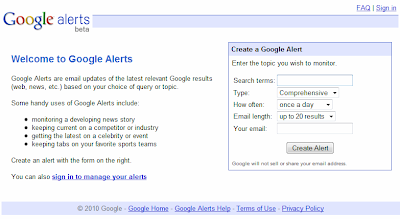
The way it works is simple: you go to the Google Alerts page and set up a separate Alert for each word or phrase you'd like reported back to you. Note that you don't have to have a Google or Gmail account to do this.
What Alerts Should Authors Have?
I recommend authors set up alerts for their author or pen name(s), the titles of each of their books, the name(s) of their blog(s) and/or website(s), and the names of any events, sites, etc. with which the author is affiliated. I also recommend the following settings for Alerts:
Type: Comprehensive - so you don't miss any mentions
How Often: once a day or once a week - so you're not inundated with Alert emails
Email Length: up to 20 results - this limit will probably far exceed the actual number of results in your Alerts for a very long time
Author Workshop Cruise
my Alert would include any references to "Author", "Workshop", or "Cruise". If I enter the search term like this:
"Author Workshop Cruise"
my Alert will only include references to the entire phrase, "Author Workshop Cruise".
Alerts based on general search terms will return a lot of false positives even when you employ quotation marks, but it can't be helped in some cases. For example, I've set up an Alert for ' "Snow Ball" + novel ' to be notified anytime my novel Snow Ball is being bandied about online, but I also get a lot of hits from people who are talking about about actual balls of snow. Still, I'd rather scan through a few false positives each day than stay in the dark about it when people are talking about my book.
Only people with Google/Gmail accounts can make changes to their existing Alerts, and this is accomplished via the "Manage Alerts" link in any alert email. Users without Google/Gmail accounts can only delete existing Alerts and add new ones. If you don't have a Google/Gmail account and you need to change one of your Alerts, here's how to do it:
1. Copy down the parameters of the Alert from within one of its Alert emails, and mark the email with a star or file it in a location where you can easily locate it later
2. Go to the Google Alerts page and create a new Alert, using as many of the parameters you copied as you wish, and changing any you need to change
3. After you've received an Alert from the newly-created version (so you know it's working), return to the Alert email from which you copied the parameters, and click the "Delete this alert" link
How To React To An Alert
When an Alert notifies you of a positive mention, go to the site and see if comments are enabled. If they are, leave a note of thanks to the post's author, along with any additional remarks you can offer about the article, discussion topic, or post in question. Be sure to check off the "be notified of any responses" box, if there is one, so if anyone replies to your comment you'll be notified and can come back to respond. Also be sure to spread the word by sharing a link to the page whenever appropriate. This is a win-win that rewards the person who mentioned you or your work by driving traffic to their site, and strengthens your author platform by demonstrating that people are saying nice things about you or your work.
You will be amazed at what a big impact your response and publicity can have on the people who've mentioned you or your work. They will feel validated and appreciated, and will be that much more likely to sing your praises whenever the opportunity arises.
When an Alert notifies you of a negative mention, you'll need to decide whether or not it will be productive for you to respond. In most cases, it isn't. Please see these posts for additional guidance:
Congratulations, You Get To Be The Bigger Person Now
Internet Defamation, Author Platform, And You
So head on over to Google Alerts and get your personal tattle-tale on the job right away!
How To Use Google Alerts
The way it works is simple: you go to the Google Alerts page and set up a separate Alert for each word or phrase you'd like reported back to you. Note that you don't have to have a Google or Gmail account to do this.

Under "Type" you can specify whether you want the Alert to search News (news reporting sites), Blogs, Web (non-blog websites), Video (video sharing sites like YouTube), Groups (online communities), or Comprehensive (any mention on any site). Under "How often" you can tell Google Alerts to notify you as-it-happens, once a day or once a week. Anytime the word or phrase you've specified turns up online, Google Alerts sends you an email with a link to the page where the mention occurred. For "Email length" you can choose an upper limit of 20 results or 50 results per email notification. Then you just enter your email address, click the Create Alert button, and your personal tattle-tale is on the job.
What Alerts Should Authors Have?
I recommend authors set up alerts for their author or pen name(s), the titles of each of their books, the name(s) of their blog(s) and/or website(s), and the names of any events, sites, etc. with which the author is affiliated. I also recommend the following settings for Alerts:
Type: Comprehensive - so you don't miss any mentions
How Often: once a day or once a week - so you're not inundated with Alert emails
Email Length: up to 20 results - this limit will probably far exceed the actual number of results in your Alerts for a very long time
Be sure to enter your Alert search terms the same as you would in a search engine. Use quotation marks around phrases and full names to avoid a lot of incorrect results. For example, if I entered the Alert search for Publetariat's Author Workshop Cruise like this:
Author Workshop Cruise
my Alert would include any references to "Author", "Workshop", or "Cruise". If I enter the search term like this:
"Author Workshop Cruise"
my Alert will only include references to the entire phrase, "Author Workshop Cruise".
Alerts based on general search terms will return a lot of false positives even when you employ quotation marks, but it can't be helped in some cases. For example, I've set up an Alert for ' "Snow Ball" + novel ' to be notified anytime my novel Snow Ball is being bandied about online, but I also get a lot of hits from people who are talking about about actual balls of snow. Still, I'd rather scan through a few false positives each day than stay in the dark about it when people are talking about my book.
Only people with Google/Gmail accounts can make changes to their existing Alerts, and this is accomplished via the "Manage Alerts" link in any alert email. Users without Google/Gmail accounts can only delete existing Alerts and add new ones. If you don't have a Google/Gmail account and you need to change one of your Alerts, here's how to do it:
1. Copy down the parameters of the Alert from within one of its Alert emails, and mark the email with a star or file it in a location where you can easily locate it later
2. Go to the Google Alerts page and create a new Alert, using as many of the parameters you copied as you wish, and changing any you need to change
3. After you've received an Alert from the newly-created version (so you know it's working), return to the Alert email from which you copied the parameters, and click the "Delete this alert" link
How To React To An Alert
When an Alert notifies you of a positive mention, go to the site and see if comments are enabled. If they are, leave a note of thanks to the post's author, along with any additional remarks you can offer about the article, discussion topic, or post in question. Be sure to check off the "be notified of any responses" box, if there is one, so if anyone replies to your comment you'll be notified and can come back to respond. Also be sure to spread the word by sharing a link to the page whenever appropriate. This is a win-win that rewards the person who mentioned you or your work by driving traffic to their site, and strengthens your author platform by demonstrating that people are saying nice things about you or your work.
You will be amazed at what a big impact your response and publicity can have on the people who've mentioned you or your work. They will feel validated and appreciated, and will be that much more likely to sing your praises whenever the opportunity arises.
When an Alert notifies you of a negative mention, you'll need to decide whether or not it will be productive for you to respond. In most cases, it isn't. Please see these posts for additional guidance:
Congratulations, You Get To Be The Bigger Person Now
Internet Defamation, Author Platform, And You
So head on over to Google Alerts and get your personal tattle-tale on the job right away!
Monday, November 16, 2009
An Indie Call To Action
Most of us indie authors talk a good game about how there are plenty of quality indie books available, and how there are plenty of terrible mainstream books. We also like to complain about the lack of variety and originality in mainstream book offerings as compared to indie books. Such musings generally lead to the conclusion that if people would just give indie books the same chance they give to mainstream books, if they would just put indie books to the ‘fifteen minute’ or ‘first ten pages’ test, the frequency with which they’d find books they would want to keep reading would be on par with that for mainstream books, and indie authors and readers everywhere would rejoice. It’s time we stop all the hand-wringing and blind hope, and make this happen.
Yes, we have the power. Every indie author is also a reader, and every one of us has a circle of influence. So if you’re an indie author or small imprint owner, I issue the following challenge to you:
1) Find an indie book you LOVE, from an author to whom you have no connection. The lack of a prior connection or relationship is important, since it will eliminate any possibility of a conflict of interest. Finding the right book will require you to put a few likely candidates to the fifteen minute/ten pages test, but if you’re not willing to do it, why should any prospective reader out there do it for your book?
2) Write positive reviews of your chosen book on every site where the book can be bought (e.g., Amazon, Smashwords, Scribd, Lulu store, Authors Bookshop, etc.; most allow you to enter reviews whether you bought a given book on their site or not) and on any reader community sites to which you belong (e.g., Goodreads, Shelfari, LibraryThing).
3) If you’re on Twitter, tweet about the book and author, and include a link to a page where the book can be purchased. Use the hashtag #indieaction, to make it easy for everyone to find these indie action tweets (and some great indie books!).
4) Add the author’s site to your blogroll or links page on your own site.
5) If you were already planning to buy books as holiday gifts and your chosen book is available for sale, include it in your gift mix.
6) If you typically review books on your blog or website from time to time, review the book there as well. If you don’t typically post full reviews, just add a one- to two-liner about the book and author at the end of another blog post. Link back to this post if you feel you need to put your remarks into context.
7) Recommend the book personally to family, friends and coworkers.
8) Spread the word about this campaign to every indie author and indie supporter you know. Here’s a handy link you can share for this post –
http://bit.ly/13kM5j
This is not a shady scheme, and this is not a mutual back-scratching society. This is the many thousands of indie authors flexing their collective influence as readers for the benefit of the indie author movement overall.
Maybe you’ve never actively sought out indie books to read, and don’t know where to start. I’d suggest you begin by checking the top-selling, most-downloaded, and/or top-rated books at any of the sites listed below. Most of the bookseller sites listed allow authors to post a free excerpt (for your 15 minute/ten pages test); for other books, try looking up the author’s website to see if you can find an excerpt that way. Again, some time and effort will be involved here but you can gain a lot of insight into the typical book-buyer’s experience with indie books by going through this exercise.
Web Fiction Guide
LL Book Review
Small-Press Bookwatch
Scribd*
Smashwords*
Podiobooks (podcast audiobooks)
Authorsbookshop
Self-Publishing Review
The New Podler Review of Books
Top 100 Kindle Store Independent Authors
*These sites offer both indie and mainstream books, so you'll need to check the publisher name to see if you're dealing with an indie/small imprint book, or a mainstream release
I’m going to get the ball rolling by recommending an excellent indie book from an author who’s a complete stranger to me. The book is called The 6th Seal, and it was written by J.M. Emanuel. It’s an excellent, and truly scary, supernatural thriller set against an archetypal good vs. evil backdrop. If you enjoyed The Da Vinci Code but wished it had more depth, if you enjoy books by Straub and Stephen King, or any of the darker works of Neil Gaiman, if you like fictional explorations of Armageddon, mysteries, or stories built on biblical revelation, you really ought to give this book a try. You can read the first few pages of it using the Look Inside! Feature on Amazon.com, where it’s available in both print and Kindle editions.
In the coming week I’ll put my keyboard where my mouth is by tweeting and posting reviews of this book everywhere I can.
Now get out there and become part of the solution!
Yes, we have the power. Every indie author is also a reader, and every one of us has a circle of influence. So if you’re an indie author or small imprint owner, I issue the following challenge to you:
1) Find an indie book you LOVE, from an author to whom you have no connection. The lack of a prior connection or relationship is important, since it will eliminate any possibility of a conflict of interest. Finding the right book will require you to put a few likely candidates to the fifteen minute/ten pages test, but if you’re not willing to do it, why should any prospective reader out there do it for your book?
2) Write positive reviews of your chosen book on every site where the book can be bought (e.g., Amazon, Smashwords, Scribd, Lulu store, Authors Bookshop, etc.; most allow you to enter reviews whether you bought a given book on their site or not) and on any reader community sites to which you belong (e.g., Goodreads, Shelfari, LibraryThing).
3) If you’re on Twitter, tweet about the book and author, and include a link to a page where the book can be purchased. Use the hashtag #indieaction, to make it easy for everyone to find these indie action tweets (and some great indie books!).
4) Add the author’s site to your blogroll or links page on your own site.
5) If you were already planning to buy books as holiday gifts and your chosen book is available for sale, include it in your gift mix.
6) If you typically review books on your blog or website from time to time, review the book there as well. If you don’t typically post full reviews, just add a one- to two-liner about the book and author at the end of another blog post. Link back to this post if you feel you need to put your remarks into context.
7) Recommend the book personally to family, friends and coworkers.
8) Spread the word about this campaign to every indie author and indie supporter you know. Here’s a handy link you can share for this post –
http://bit.ly/13kM5j
This is not a shady scheme, and this is not a mutual back-scratching society. This is the many thousands of indie authors flexing their collective influence as readers for the benefit of the indie author movement overall.
Maybe you’ve never actively sought out indie books to read, and don’t know where to start. I’d suggest you begin by checking the top-selling, most-downloaded, and/or top-rated books at any of the sites listed below. Most of the bookseller sites listed allow authors to post a free excerpt (for your 15 minute/ten pages test); for other books, try looking up the author’s website to see if you can find an excerpt that way. Again, some time and effort will be involved here but you can gain a lot of insight into the typical book-buyer’s experience with indie books by going through this exercise.
Web Fiction Guide
LL Book Review
Small-Press Bookwatch
Scribd*
Smashwords*
Podiobooks (podcast audiobooks)
Authorsbookshop
Self-Publishing Review
The New Podler Review of Books
Top 100 Kindle Store Independent Authors
*These sites offer both indie and mainstream books, so you'll need to check the publisher name to see if you're dealing with an indie/small imprint book, or a mainstream release
I’m going to get the ball rolling by recommending an excellent indie book from an author who’s a complete stranger to me. The book is called The 6th Seal, and it was written by J.M. Emanuel. It’s an excellent, and truly scary, supernatural thriller set against an archetypal good vs. evil backdrop. If you enjoyed The Da Vinci Code but wished it had more depth, if you enjoy books by Straub and Stephen King, or any of the darker works of Neil Gaiman, if you like fictional explorations of Armageddon, mysteries, or stories built on biblical revelation, you really ought to give this book a try. You can read the first few pages of it using the Look Inside! Feature on Amazon.com, where it’s available in both print and Kindle editions.
In the coming week I’ll put my keyboard where my mouth is by tweeting and posting reviews of this book everywhere I can.
Now get out there and become part of the solution!
Thursday, October 8, 2009
Don’t Be Part of the 5%: Master The 5 Crucial Author Platform Skills
For the past several months, I’ve been working on the Publetariat Vault. Among the hundreds of authors who’ve registered for Vault membership, about 5% are completely overwhelmed by the listing form. They refuse to read or follow the instructions on the form, or think 17 required fields are too much to ask, or don’t know how to create a synopsis or excerpt in pdf, rtf or txt format, or don’t know how to upload files to the site using the typical “Browse” + “Upload” button combo. And they’re kind of pissed off that we’re asking them to do all of this in the first place, they’re walking away from up to 5 months’ free listing time on account of tech frustration. A couple of years ago I would’ve said the 5% are absolutely right, such a form is too demanding and no author should be expected to have that level of tech savvy. But the bar has been raised, and nowadays any author with a strong platform has all the skills necessary to easily complete the Vault form. The rest can no longer afford to be part of the 5%. It's not fair, and it has nothing to do with quality writing, but it is the reality.
Any author who’s not yet heard the term “author platform” could only have been lost at sea or living in Amish country, but even among those who know it, I’m finding the term is often not fully understood. Many authors, both aspiring and published, indie and mainstream, think succeeding with author platform means having a blog or author website. And maybe they Twitter a little, or have a Facebook or MySpace page. They also often think author platform is something that’s very difficult and/or expensive, and only applicable to published authors.
They are wrong, on all counts.
Author platform encompasses everything you do both to promote your work and to establish yourself as a “brand” in the marketplace, and ideally, it begins long before you have a book to sell. Even if you intend to go the totally mainstream route of writing the best damned manuscript you can and then querying agents and publishers, you can no longer expect to get a pass on author platform. I’m currently working with Writers Digest on the publication of a revised and updated edition of my book, The IndieAuthor Guide, and when our talks began the very first questions they had for me were all about my author platform. What websites do I have, and how much traffic do they get? How many pageviews, how many unique visitors? How frequently do I blog? How frequently do I have public speaking engagements, and where and for whom have I done such engagements? Do I maintain an email newsletter or membership list, and if so, how large is it?
If you’re lucky enough to get a request for the full manuscript from an agent or publisher, are you prepared to answer all these questions? Because if you’re not, you’re not ready to have your full ms requested. And if you’re intending to self-publish, you should be asking these questions of yourself already.
Lucky for all of us, the minimum skills needed to do a pretty decent job with online author platform are few, and easy to master. The way it works is, with each new skill you acquire, new online promotion and publication options are opened to you. And when it comes to author platform, you want every available option at your disposal.
You must know how to use webforms to comment on articles or blog posts online, create and maintain your own blog, create and maintain a fill-in-the-blanks sort of author website, or have a Facebook or MySpace page.
If you also want to provide an online cover image of your book, or an author photo, you must either know how to create digital images (pictures a computer can read because they’re stored as a computer file; if you use a digital camera and know how to get the pictures off your camera and onto your computer, you already know how to create digital images) or have the images supplied by someone who does know how to create them, you must know how to use a graphics editor program to resize the images as needed to meet the file size and dimension requirements of the various sites on which you intend to share them, and you must know how upload files to a web server using a “Browse” + “Upload” button combo.
All the skills mentioned thus far are also needed to self-publish your work in hard copy formats via an online print service provider such as Createspace or Lulu, and to self-publish in various ebook formats via online ebook conversion services such as Smashwords or Scribd.
If you want to make excerpts of your work available for free viewing on your blog or website (which is one of the cheapest and most effective ways of growing readership), on top of everything else you must also know how to create an excerpt of the full work and output that excerpt to pdf format.
Let’s stop and take inventory. If you know how to use webforms, how to create and resize digital images, how to upload files to a web server and how to output your work in pdf format, you’ve got most of your self-publishing and online author platform options covered with just five basic tech skills. You can have a blog and a fill-in-the-blanks type of author website. You can comment on blogs and articles all over the ‘net. You can publish your work in multiple formats and make it available for sale online through various outlets. You can make excerpts of your work available online. You can Facebook, MySpace and LinkedIn to your heart’s content---and you can do all of these things for the cost of nothing more than your time and the price of a single author copy (in cases where you're self-pubbing in hard copy)! You'd be a fool to turn your back on such an embarrassment of author platform riches, but that's what the 5% do every day.
Now, if you also want to Twitter, you’ll want to bone up on web abbreviations, emoticons and hashtags. If you want to be able to add cool little widgets (e.g., hit counters, ‘my Goodreads bookshelf’, BookBuzzr, etc.) to your blog, author website, Facebook, MySpace or other online pages, you’ll need to be comfortable copying and pasting snippets of HTML or script code from the widget provider into the desired location, but even then, someone else is providing the code and all you’re doing is copying and pasting it the same as you’d do with any ordinary text. The best part is, most such widgets are available for free! If you don't know how to use them, you're missing a huge opportunity to jazz up your platform at no cost.
When you’re ready to graduate to the master class, you can learn about RSS syndication and how to set up a simple web form on your site or blog to allow your readers to subscribe to your email newsletter, but this is nothing you need to think about right away.
For now, just focus on mastering the 5 crucial author platform skills and get yourself out of that doomed 5%.
Addendum: Regarding the Vault form, I'm the first to admit it's a lengthy form. Authors will need to spend half an hour or so pulling together all the information they need to create a listing, and an additional 5-10 minutes to complete the form. However, the form includes very detailed instructions for every section and field, required fields are limited to those items publishers have said are most important in making acquisitions decisions, and authors participating in the Vault's current promotions are getting several months' free listing time. I'm sure those who go on to strike deals with publishers or producers will feel it was well worth filling out the form.
Any author who’s not yet heard the term “author platform” could only have been lost at sea or living in Amish country, but even among those who know it, I’m finding the term is often not fully understood. Many authors, both aspiring and published, indie and mainstream, think succeeding with author platform means having a blog or author website. And maybe they Twitter a little, or have a Facebook or MySpace page. They also often think author platform is something that’s very difficult and/or expensive, and only applicable to published authors.
They are wrong, on all counts.
Author platform encompasses everything you do both to promote your work and to establish yourself as a “brand” in the marketplace, and ideally, it begins long before you have a book to sell. Even if you intend to go the totally mainstream route of writing the best damned manuscript you can and then querying agents and publishers, you can no longer expect to get a pass on author platform. I’m currently working with Writers Digest on the publication of a revised and updated edition of my book, The IndieAuthor Guide, and when our talks began the very first questions they had for me were all about my author platform. What websites do I have, and how much traffic do they get? How many pageviews, how many unique visitors? How frequently do I blog? How frequently do I have public speaking engagements, and where and for whom have I done such engagements? Do I maintain an email newsletter or membership list, and if so, how large is it?
If you’re lucky enough to get a request for the full manuscript from an agent or publisher, are you prepared to answer all these questions? Because if you’re not, you’re not ready to have your full ms requested. And if you’re intending to self-publish, you should be asking these questions of yourself already.
Lucky for all of us, the minimum skills needed to do a pretty decent job with online author platform are few, and easy to master. The way it works is, with each new skill you acquire, new online promotion and publication options are opened to you. And when it comes to author platform, you want every available option at your disposal.
You must know how to use webforms to comment on articles or blog posts online, create and maintain your own blog, create and maintain a fill-in-the-blanks sort of author website, or have a Facebook or MySpace page.
If you also want to provide an online cover image of your book, or an author photo, you must either know how to create digital images (pictures a computer can read because they’re stored as a computer file; if you use a digital camera and know how to get the pictures off your camera and onto your computer, you already know how to create digital images) or have the images supplied by someone who does know how to create them, you must know how to use a graphics editor program to resize the images as needed to meet the file size and dimension requirements of the various sites on which you intend to share them, and you must know how upload files to a web server using a “Browse” + “Upload” button combo.
All the skills mentioned thus far are also needed to self-publish your work in hard copy formats via an online print service provider such as Createspace or Lulu, and to self-publish in various ebook formats via online ebook conversion services such as Smashwords or Scribd.
If you want to make excerpts of your work available for free viewing on your blog or website (which is one of the cheapest and most effective ways of growing readership), on top of everything else you must also know how to create an excerpt of the full work and output that excerpt to pdf format.
Let’s stop and take inventory. If you know how to use webforms, how to create and resize digital images, how to upload files to a web server and how to output your work in pdf format, you’ve got most of your self-publishing and online author platform options covered with just five basic tech skills. You can have a blog and a fill-in-the-blanks type of author website. You can comment on blogs and articles all over the ‘net. You can publish your work in multiple formats and make it available for sale online through various outlets. You can make excerpts of your work available online. You can Facebook, MySpace and LinkedIn to your heart’s content---and you can do all of these things for the cost of nothing more than your time and the price of a single author copy (in cases where you're self-pubbing in hard copy)! You'd be a fool to turn your back on such an embarrassment of author platform riches, but that's what the 5% do every day.
Now, if you also want to Twitter, you’ll want to bone up on web abbreviations, emoticons and hashtags. If you want to be able to add cool little widgets (e.g., hit counters, ‘my Goodreads bookshelf’, BookBuzzr, etc.) to your blog, author website, Facebook, MySpace or other online pages, you’ll need to be comfortable copying and pasting snippets of HTML or script code from the widget provider into the desired location, but even then, someone else is providing the code and all you’re doing is copying and pasting it the same as you’d do with any ordinary text. The best part is, most such widgets are available for free! If you don't know how to use them, you're missing a huge opportunity to jazz up your platform at no cost.
When you’re ready to graduate to the master class, you can learn about RSS syndication and how to set up a simple web form on your site or blog to allow your readers to subscribe to your email newsletter, but this is nothing you need to think about right away.
For now, just focus on mastering the 5 crucial author platform skills and get yourself out of that doomed 5%.
Addendum: Regarding the Vault form, I'm the first to admit it's a lengthy form. Authors will need to spend half an hour or so pulling together all the information they need to create a listing, and an additional 5-10 minutes to complete the form. However, the form includes very detailed instructions for every section and field, required fields are limited to those items publishers have said are most important in making acquisitions decisions, and authors participating in the Vault's current promotions are getting several months' free listing time. I'm sure those who go on to strike deals with publishers or producers will feel it was well worth filling out the form.
Tuesday, September 22, 2009
Self-Publishing: Future Prerequisite
Until recently, if you were self-published virtually any agent or book editor worth her salt didn’t want to hear about it. Many of them would want nothing to do with you at all, as if your self-published status might rub their own cachet off or something. But given the tenor and content of the sessions at this year’s Writers Digest Business of Getting Published Conference, I predict it won’t be long before agents and editors will routinely respond to queries by asking what you’ve self-published, and how it’s doing. That’s right, and you heard it here first:
At the conference, the prevailing message was that authors, both aspiring and already published, need to be getting themselves and their work out there in front of the reading public at every opportunity. And guess what? If you’re blogging or making your writing available for download in ebook or podcast formats you're already self-publishing. As for those who aren’t doing these things for fear of intellectual property theft, in numerous sessions attendees were reminded of Tim O’Reilly’s now legendary quote: that for anyone trying to build an audience, “Obscurity is a greater threat than piracy.”
Seth Harwood and Scott Sigler, both of whom broke through to mainstream success after building an audience for their podcasts, advised conference attendees that the best way to get publishers to sit up and take notice is to demonstrate your ability to build an audience and move your material on your own. Social media guru Chris Brogan said the easiest way to get a book deal is not to need one---because you’ve already established your own platform and have your own audience---, and proposed that rather than follow established roads, aspiring authors should go where there are no roads and create their own. Writers Digest Publisher and Editorial Director Jane Friedman reminded us that here in the 21st century there are no longer any rules in publishing, and reiterated the notion that for aspiring authors, platform comes before the book deal. Be The Media author David Mathison hammered away at the importance of connecting with your readership directly. Booksquare’s Kassia Krozser urged authors to push out into every available channel to enable readers to find them, and as for The Writer Mama Christina Katz, the title of her most recent book is Get Known Before The Book Deal ('nuff said!).
So, how do you intend to enable readers to find you, or build an audience, or connect with readers directly, or get known before the book deal if you’re not publishing or podcasting any of your work? You can’t just tell your site or blog visitors your writing is great, they should trust you on that, and then expect to hold their interest with what amounts to a lengthy series of hang-in-there-I-swear-when-the-book-comes-out-you’ll-love-it messages.
As we all already know, a manuscript’s content is only one piece---an increasingly small piece, unfortunately---of the decision-making puzzle when it comes to convincing a publisher to make an offer. When the editors, marketing wonks and other decision makers get together to consider which manuscripts to acquire, Risk is the name of the elephant in the room and mitigating risk is the key to a sale. When you approach an agent or editor with a quality manuscript, you may convince them you can write but you’re doing nothing to reduce their fears about the eventual book’s performance in the marketplace. If you can approach those same people with a book that’s already in the marketplace and already has a fan base, you’ve already answered the question of how the book will perform post-publication. You’ve reduced their antacid intake by half and given them some very good reasons to invest in you and your book.
Don’t let anyone tell you self-publishing is a desperation move. It’s a power move.
I predict that within 5 years, self-publishing will no longer be an option, but a prerequisite for unknown, aspiring authors hoping to land a mainstream publishing deal. It’s the logical, inevitable next step in author platform.
At the conference, the prevailing message was that authors, both aspiring and already published, need to be getting themselves and their work out there in front of the reading public at every opportunity. And guess what? If you’re blogging or making your writing available for download in ebook or podcast formats you're already self-publishing. As for those who aren’t doing these things for fear of intellectual property theft, in numerous sessions attendees were reminded of Tim O’Reilly’s now legendary quote: that for anyone trying to build an audience, “Obscurity is a greater threat than piracy.”
Seth Harwood and Scott Sigler, both of whom broke through to mainstream success after building an audience for their podcasts, advised conference attendees that the best way to get publishers to sit up and take notice is to demonstrate your ability to build an audience and move your material on your own. Social media guru Chris Brogan said the easiest way to get a book deal is not to need one---because you’ve already established your own platform and have your own audience---, and proposed that rather than follow established roads, aspiring authors should go where there are no roads and create their own. Writers Digest Publisher and Editorial Director Jane Friedman reminded us that here in the 21st century there are no longer any rules in publishing, and reiterated the notion that for aspiring authors, platform comes before the book deal. Be The Media author David Mathison hammered away at the importance of connecting with your readership directly. Booksquare’s Kassia Krozser urged authors to push out into every available channel to enable readers to find them, and as for The Writer Mama Christina Katz, the title of her most recent book is Get Known Before The Book Deal ('nuff said!).
So, how do you intend to enable readers to find you, or build an audience, or connect with readers directly, or get known before the book deal if you’re not publishing or podcasting any of your work? You can’t just tell your site or blog visitors your writing is great, they should trust you on that, and then expect to hold their interest with what amounts to a lengthy series of hang-in-there-I-swear-when-the-book-comes-out-you’ll-love-it messages.
As we all already know, a manuscript’s content is only one piece---an increasingly small piece, unfortunately---of the decision-making puzzle when it comes to convincing a publisher to make an offer. When the editors, marketing wonks and other decision makers get together to consider which manuscripts to acquire, Risk is the name of the elephant in the room and mitigating risk is the key to a sale. When you approach an agent or editor with a quality manuscript, you may convince them you can write but you’re doing nothing to reduce their fears about the eventual book’s performance in the marketplace. If you can approach those same people with a book that’s already in the marketplace and already has a fan base, you’ve already answered the question of how the book will perform post-publication. You’ve reduced their antacid intake by half and given them some very good reasons to invest in you and your book.
Don’t let anyone tell you self-publishing is a desperation move. It’s a power move.
Sunday, September 6, 2009
How To Lose Fans and Alienate Visitors
Hi, Joe or Jane Author. My name is...well, it doesn’t really matter what my name is, all that matters is I’ve just signed up for your newsletter, or started visiting your site or blog, or registered for membership on your site, or started following you on Twitter, or friended you on Facebook or MySpace or FriendFeed or Goodreads or LibraryThing or something similar. This should be the start of a wonderful relationship, in which you share useful and amusing information with me and I sing your praises to everyone I know, buy your books, register for your webinars and show up to your speaking engagements. So far, so good. Now here’s how to f**k it up.
Bombard me with emails. When I signed up for your newsletter, Helpful Tips or the like, unless you specified otherwise at the time I signed up, I’m expecting to hear from you no more frequently than once a week. And in all honesty, if your messages take longer than about five minutes to read, I won't. Between my job, my family commitments, my social commitments, my own reading and writing, and the fall TV schedule ramping up again, I don’t have time to wade through your too-frequent or too-lengthy missives.
Bait and switch me. It might surprise you to learn that when I signed up for your newsletter or Helpful Tips I was expecting to receive…wait for it…news or Helpful Tips, NOT advertising messages. It’s fine to have a one- or two-line sales pitch at the end of your email, or to send out the occasional message about your upcoming book or speaking engagement, but the rest of your content better be worth my time and attention. Look at it this way: would you read a magazine that had nothing but full-page ads in it? If your favorite TV show suddenly started consisting of 80% ads and 20% show, would you keep watching it?
Son of bait and switch me. If you’ve promoted your free webinar, ebook, members-only site, newsletter or whatever else you’ve got as Twenty Surefire Strategies to accomplish some goal, and I sign up, I’m expecting to receive…you guessed it: Twenty Surefire Strategies. When you give me a series of sales pitches for twenty fee-based products or services from you and your affiliates instead, I tend to conclude you’re a lying liar.
Return of the son of bait and switch me. Goodreads, LibraryThing, Shelfari and other reader community sites are places where people share their reactions to books they’ve read and engage in discussions about all things book-related, generally from a reader’s perspective. If the only books on your virtual shelf are those you’ve written yourself, or if you’ve got a variety of books on display but reserve your gushiest reviews for your own work, it’s obvious you’re using the site as a marketing outlet. Way to give new authors everywhere a bad name.
Bait and switch me, the revenge. It’s great that you’re branching out into new areas, or already operating in multiple areas, but don’t assume I want to branch out with you. I signed up for your Sci Fi Wonks site because I enjoy science fiction in general, and yours in particular. Imagine my surprise (and annoyance) when I also started receiving emails from your Gory Horrors site. And your Renaissance Romance N’ Ribaldry site. And your [insert religious affiliation here] Inspiration Of The Day site. And your eBay store. Bonus question: how angry do you think I was to find there were no “unsubscribe” links in any of the unwanted emails?
Bait and switch me, the final chapter. I understand I may need to provide my email address when posting a comment on your blog or site, because it protects you from spammers and hackers. And of course, if I’ve used the Contact form to send you a remark or question off-site, you need my email address to respond to me. But neither of these actions gives you the right to add me to your mailing list. Even if you’ve added some verbiage to your site pages to indicate that’s what you’ll do anytime someone enters his or her email address anywhere on your site, since that’s not howupstanding and honest most sites operate, if you want to avoid any appearance of bait-and-switchery you need to have a separate page just for mailing list signups.
Bait and switch me, the remake. Facebook, Twitter, FriendFeed, MySpace and other social networking sites are intended for…seriously, do I have to say it? Social networking. Not marketing or sales pitches. If most (or worse, all!) of your tweets, status updates or blog entries are only there to promote yourself or your work, you’re wasting my time. Just like I said about signing up for your newsletter or Helpful Tips, I wasn’t expecting to get a steady stream of advertising.
Are you beginning to sense a common thread? When I’m getting a lot of quality content from you, I don’t mind getting a modicum of advertising and promotion too. Sometimes I’m truly glad to hear about your new book, service or product, especially if I’m getting a special discount, premium edition or access to material or events not made available to the general public. But the moment the balance between content and advertising tips in the direction of advertising, I’m out. The moment I start thinking you’ve abused my trust, I’m out AND spreading the word. So please, don’t make me tweet angry.
Bombard me with emails. When I signed up for your newsletter, Helpful Tips or the like, unless you specified otherwise at the time I signed up, I’m expecting to hear from you no more frequently than once a week. And in all honesty, if your messages take longer than about five minutes to read, I won't. Between my job, my family commitments, my social commitments, my own reading and writing, and the fall TV schedule ramping up again, I don’t have time to wade through your too-frequent or too-lengthy missives.
Bait and switch me. It might surprise you to learn that when I signed up for your newsletter or Helpful Tips I was expecting to receive…wait for it…news or Helpful Tips, NOT advertising messages. It’s fine to have a one- or two-line sales pitch at the end of your email, or to send out the occasional message about your upcoming book or speaking engagement, but the rest of your content better be worth my time and attention. Look at it this way: would you read a magazine that had nothing but full-page ads in it? If your favorite TV show suddenly started consisting of 80% ads and 20% show, would you keep watching it?
Son of bait and switch me. If you’ve promoted your free webinar, ebook, members-only site, newsletter or whatever else you’ve got as Twenty Surefire Strategies to accomplish some goal, and I sign up, I’m expecting to receive…you guessed it: Twenty Surefire Strategies. When you give me a series of sales pitches for twenty fee-based products or services from you and your affiliates instead, I tend to conclude you’re a lying liar.
Return of the son of bait and switch me. Goodreads, LibraryThing, Shelfari and other reader community sites are places where people share their reactions to books they’ve read and engage in discussions about all things book-related, generally from a reader’s perspective. If the only books on your virtual shelf are those you’ve written yourself, or if you’ve got a variety of books on display but reserve your gushiest reviews for your own work, it’s obvious you’re using the site as a marketing outlet. Way to give new authors everywhere a bad name.
Bait and switch me, the revenge. It’s great that you’re branching out into new areas, or already operating in multiple areas, but don’t assume I want to branch out with you. I signed up for your Sci Fi Wonks site because I enjoy science fiction in general, and yours in particular. Imagine my surprise (and annoyance) when I also started receiving emails from your Gory Horrors site. And your Renaissance Romance N’ Ribaldry site. And your [insert religious affiliation here] Inspiration Of The Day site. And your eBay store. Bonus question: how angry do you think I was to find there were no “unsubscribe” links in any of the unwanted emails?
Bait and switch me, the final chapter. I understand I may need to provide my email address when posting a comment on your blog or site, because it protects you from spammers and hackers. And of course, if I’ve used the Contact form to send you a remark or question off-site, you need my email address to respond to me. But neither of these actions gives you the right to add me to your mailing list. Even if you’ve added some verbiage to your site pages to indicate that’s what you’ll do anytime someone enters his or her email address anywhere on your site, since that’s not how
Bait and switch me, the remake. Facebook, Twitter, FriendFeed, MySpace and other social networking sites are intended for…seriously, do I have to say it? Social networking. Not marketing or sales pitches. If most (or worse, all!) of your tweets, status updates or blog entries are only there to promote yourself or your work, you’re wasting my time. Just like I said about signing up for your newsletter or Helpful Tips, I wasn’t expecting to get a steady stream of advertising.
Are you beginning to sense a common thread? When I’m getting a lot of quality content from you, I don’t mind getting a modicum of advertising and promotion too. Sometimes I’m truly glad to hear about your new book, service or product, especially if I’m getting a special discount, premium edition or access to material or events not made available to the general public. But the moment the balance between content and advertising tips in the direction of advertising, I’m out. The moment I start thinking you’ve abused my trust, I’m out AND spreading the word. So please, don’t make me tweet angry.
Saturday, February 14, 2009
Virtual Book Launch Party
Everyone is invited to a free online party to celebrate the launch of Anne Cordwainer's new book, Modern Magic. Check out this review, from an author more than a few of us have heard of:
“I love it! The magic framework is well worked out, the writing is apt, and the crises are scary . . . . this is a fun novel.”
-Piers Anthony
At the online party you'll find great music, pointers to great books, free games, amusing food for thought, and more. The party will only last a week, so visit while you can. Here's the party link, once again.
“I love it! The magic framework is well worked out, the writing is apt, and the crises are scary . . . . this is a fun novel.”
-Piers Anthony
At the online party you'll find great music, pointers to great books, free games, amusing food for thought, and more. The party will only last a week, so visit while you can. Here's the party link, once again.
Lessons Learned From #TOC: Don't Be A Jerk
Don't believe what you hear about New Yorkers being rude. During the four days I was there for the O'Reilly Tools of Change conference, only two people were rude to me. One was a woman who sat next to me during a showing of the musical Billy Elliot. The other was an author in attendance at the conference. I've blurred the details in relating my experience with the author here, but there's still an important lesson to be learned from it.
I'd long been a fan of this author and a regular follower of her blog and online columns for various publications, and had long pondered a specific passage in one of her books. Seeing her at the conference, I figured this was my chance to ask her for further clarification directly. Her response was curt. She tersely said I'd completely misunderstood the passage and rather than indulge me with further explanation, directed me back to her site. Not surprisingly, my impression of this author has changed entirely, for the worse, and my new, negative impression will undoubtedly color my opinion of all her work in the future.
In fairness to this multi-published, big-name author, it must be said that she probably receives queries like mine all the time and is sick and tired of having to answer the same questions from the boneheaded public over and over again. However, in fairness to the boneheaded public, it must be said that we pay her bills and it is our desire to read and understand her work that allows this author to maintain her lifestyle and vaunted status. While I sell respectable numbers of books and get tens of thousands of hits on my various websites each month, I'm a relatively smalltime operator in the big scheme of publishing. Even so, I cared enough about this author's work to buy it and try to absorb it, and I think that's reason enough to deserve a modicum of respect from the author.
The author essentially made me regret having posed my question to her, and by extension, having spent the money and time I'd invested in her work to date. I was left to slink away in quiet embarrassment as other, better-known conference attendees swooped in and were granted a much warmer welcome by the author. What could I say? "Gee, sorry to show interest in your work, I'll try not to do it again."
As an author, you should count yourself lucky to have each and every fan, and treat every one of them with the same level of respect and interest you would show to the most famous and influential person you can imagine. In the general sense it's just plain good manners, but in the marketing sense it's critical. You may think a bumpkin housewife who accosts you to ask the most lamebrained question about your work you can imagine isn't worth your time because she's just a lamebrained, bumpkin housewife, but you're wrong. That housewife buys books, belongs to book clubs, church groups and the PTA, and comes from a large circle of family and friends in her community. Whatever she tells her circle about you is something that circle will repeat to their circles, among whom are sure to be some bloggers and influential voices---six degrees of separation and all that.
Each contact with a reader is an opportunity to make a good impression, reinforce an already good impression, or spread bad press on your own behalf. No matter how tired, frustrated or annoyed you may be feeling on the inside, paste on a smile and show your audience some respect.
I'd long been a fan of this author and a regular follower of her blog and online columns for various publications, and had long pondered a specific passage in one of her books. Seeing her at the conference, I figured this was my chance to ask her for further clarification directly. Her response was curt. She tersely said I'd completely misunderstood the passage and rather than indulge me with further explanation, directed me back to her site. Not surprisingly, my impression of this author has changed entirely, for the worse, and my new, negative impression will undoubtedly color my opinion of all her work in the future.
In fairness to this multi-published, big-name author, it must be said that she probably receives queries like mine all the time and is sick and tired of having to answer the same questions from the boneheaded public over and over again. However, in fairness to the boneheaded public, it must be said that we pay her bills and it is our desire to read and understand her work that allows this author to maintain her lifestyle and vaunted status. While I sell respectable numbers of books and get tens of thousands of hits on my various websites each month, I'm a relatively smalltime operator in the big scheme of publishing. Even so, I cared enough about this author's work to buy it and try to absorb it, and I think that's reason enough to deserve a modicum of respect from the author.
The author essentially made me regret having posed my question to her, and by extension, having spent the money and time I'd invested in her work to date. I was left to slink away in quiet embarrassment as other, better-known conference attendees swooped in and were granted a much warmer welcome by the author. What could I say? "Gee, sorry to show interest in your work, I'll try not to do it again."
As an author, you should count yourself lucky to have each and every fan, and treat every one of them with the same level of respect and interest you would show to the most famous and influential person you can imagine. In the general sense it's just plain good manners, but in the marketing sense it's critical. You may think a bumpkin housewife who accosts you to ask the most lamebrained question about your work you can imagine isn't worth your time because she's just a lamebrained, bumpkin housewife, but you're wrong. That housewife buys books, belongs to book clubs, church groups and the PTA, and comes from a large circle of family and friends in her community. Whatever she tells her circle about you is something that circle will repeat to their circles, among whom are sure to be some bloggers and influential voices---six degrees of separation and all that.
Each contact with a reader is an opportunity to make a good impression, reinforce an already good impression, or spread bad press on your own behalf. No matter how tired, frustrated or annoyed you may be feeling on the inside, paste on a smile and show your audience some respect.
Friday, January 23, 2009
Don't Dilute Your Brand
As an author, your brand is the name under which you write and the image associated with that name. It takes time, effort and lots of exposure to develop ‘brand recognition’, and whether you’re in the process of building that recognition or trying to maintain it, consistency in your image and message is very important. Be cognizant of how you are presenting your brand to the public, and strive to maintain that consistency.
For example, while it’s true that publishing online articles for Squidoo, eHow, or other online article repositories can get you lots of exposure, if that exposure is scattered across articles on various, unrelated subjects, those articles aren’t helping to solidify your position as a subject area expert and in fact, may be detracting from that position. Likewise, if your book is about leveraging new media but all your articles are on topics totally unrelated to that subject, you’re squandering an opportunity to connect the content of your articles back to your book. I’m not suggesting your articles all essentially boil down to a baldfaced sales pitch, just that in general, the subjects of your articles be drawn from your book and your one- to two-liner author bio at the end of the article include a more-information link or a where-to-buy link for your book. The article functions as a sneak preview of the book.
This isn’t to say you can’t publish the occasional off-topic article, or guest blog about your interests outside the subject matter of your book; doing so can be a way to show other facets of your abilities or personality. Just make sure those ‘other facets’ pieces aren’t competing with your primary message for attention.
For example, while it’s true that publishing online articles for Squidoo, eHow, or other online article repositories can get you lots of exposure, if that exposure is scattered across articles on various, unrelated subjects, those articles aren’t helping to solidify your position as a subject area expert and in fact, may be detracting from that position. Likewise, if your book is about leveraging new media but all your articles are on topics totally unrelated to that subject, you’re squandering an opportunity to connect the content of your articles back to your book. I’m not suggesting your articles all essentially boil down to a baldfaced sales pitch, just that in general, the subjects of your articles be drawn from your book and your one- to two-liner author bio at the end of the article include a more-information link or a where-to-buy link for your book. The article functions as a sneak preview of the book.
This isn’t to say you can’t publish the occasional off-topic article, or guest blog about your interests outside the subject matter of your book; doing so can be a way to show other facets of your abilities or personality. Just make sure those ‘other facets’ pieces aren’t competing with your primary message for attention.
Saturday, June 21, 2008
Big Chain Bookstore Death Watch
Bottom Line It For Me, Baby Version (200 Words Or Less):
In a Random House/Zogby poll released May 29, queried about their habits over the past year, 77% of respondents said they’d bought books online, 76% said they’d bought books in big chain bookstores, and percentages ranging from 16-39% named other outlets, such as supermarkets, drugstores, airports and big box stores. In other words, respondents were just as likely to buy books online as from a big chain bookstore. Asked to specify the single retail outlet from which they’d made most of their book purchases, 68% named retailers other than big chain bookstores. The breakdown is: online – 43%, chain bookstore – 32%, independent brick-and-mortar bookstores – 9%, other retail outlets – 16%.
If you’re an indie author who’s invested considerable time, money and effort trying to get your books into Borders or Barnes & Noble, or has paid higher production costs to a publisher in exchange for listings with these two chains or Ingram’s catalog, you might want to rethink your strategy. If you’re an as-yet unpublished author who has avoided self-publication primarily because the publishing mainstream has you convinced big chain presence is critical, and you know those chains are averse to stocking self-published books, it's time to reconsider.
Go On An’ Run Yo Mouth, I Ain’t Got Nuthin’ But Time Version (Can’t Promise It Won’t Go On Forever):
If you’re still focusing significant efforts on raising your visibility in Borders or Barnes & Noble, or if the difficulty of getting your self-published book into these chains is a major reason for your refusal to self-publish in the first place, the results of a Random House/Zogby Poll released May 29 will be a real eye-opener.
When asked to name the one type of retailer from which they most frequently bought books in the past year, 43% of respondents said online, 32% named chain bookstores, and 9% specified small, independent bookstores. A specific breakdown isn’t provided for the remaining 16%, but that 16% definitely aren't buying most of their books in chain bookstores. Some quick math on these numbers shows that 68% of respondents buy the majority of their books from outlets other than chain booksellers. Conversely, only 32% of respondents buy the majority of their books in chain bookstores.
In the same poll, respondents were asked to name all the places they’d bought books in the past year. Outlets most often named were online retailers (77%), chain bookstores (76%) and independent bookstores (49%). In other words, respondents were just as likely to buy online as in chain bookstores, and nearly half are also buying from independent booksellers—retailers generally more receptive to carrying indie books. Drug stores, supermarkets, warehouse clubs, big box stores and airports were also named, in percentages ranging from 16-39%, but retailers such as these usually only carry current bestsellers, discounted/remaindered titles, and gift books, so they’re not typically receptive to carrying self-published works. Parse these figures any way you like, but the truth is unavoidable: chain bookstores no longer dominate the bookselling landscape, and in fact are losing ground all the time. None of this should be surprising, and in fact it’s just a case of retail history repeating.
Do you remember precisely when you stopped going to chain music stores like Musicland, Licorice Pizza and Tower Records, and why? For me, a music fan with eclectic tastes, most often looking for artists not represented on Billboard’s charts, the birth of online retailer CDNow (later absorbed by Amazon) was the beginning of the end. No brick-and-mortar store could hope to match CDNow’s selection or prices, and if I wanted something really obscure, I knew I’d sooner find it at an indie/used record store than a chain store. For people seeking chart-toppers, the widening selection of music available at discount stores, big box stores and warehouse clubs like Target, Best Buy and CostCo sounded the music chains’ first death knell.
Department and discount stores couldn’t match the selection of a dedicated record store, but it didn’t matter because their customers were only interested in the most popular current albums, greatest-hits collections and compilations of past hits. Not only could these retailers easily offer a good selection of these low-risk offerings, they could price their titles lower than those in dedicated record stores. Record stores responded by diversifying their product mix with the introduction of videogames, VHS movies and eventually, DVDs, but it was a hopeless strategy built on an already failing business model. There were simply too many other places to get these same items more conveniently, at a lower cost, and in the case of online retailers, with a wider selection. By the time digital downloading became a mainstream phenomenon thanks to Napster, the iPod and iTunes, it was merely the last nail in a coffin already built by other powerful market forces.
Compare this death of an entire industry to chain bookstores’ current situation. Greater selection of books can be had online, at lower prices? Check. Bestsellers, gift books and discount books can be bought more conveniently at other stores, for lower prices? Check. Obscure and out-of-print books can only be found online, or in indie/used bookstores? Check. Attempts are being made to diversify product mix by introducing DVDs, CDs, toys and other products, but none of these products are being offered at lower prices or in a wider selection than through other, pre-existing retail outlets? Check.
Now, explain it to me again: why do publishers and writers continue to believe big chain bookstores still have the power to make or break careers in authorship? Why do indie authors invest in catalog listings with companies like Ingram, or choose to work with higher-priced self-publication outfits on the basis of that outfit’s ability to get catalog listings? True, without the listing your book won’t be accessible to the big bookstore chains’ corporate purchasers, nor those of any other major chain retailer that is not an Amazon affiliate (i.e., Best Buy, WalMart), but none of them were ever likely to stock your book anyway. Most of an indie author’s sales will be from efforts and outlets that aren’t in any way dependent on, nor even necessarily helped by, catalog listings. Worse yet, paying for catalog listings or working with a costlier publisher typically forces an indie author to raise the retail price of his book. This makes the book less attractive to all potential buyers while forcing those who do buy the book to subsidize the cost of its exposure in retail markets that are both small and generally outside the indie author’s reach anyway.
The bottom line is this: even if you succeed in getting a big chain bookstore to carry your self-published book, the maximum market segment you can possibly capture there now stands at 32%, and it's shrinking all the time. Does it really make sense to let 32% of book buyers dictate your choice of whether or not to self-publish, or your choice of publisher, or if you've already self-published, claim the bulk of your promotional resources?
In a Random House/Zogby poll released May 29, queried about their habits over the past year, 77% of respondents said they’d bought books online, 76% said they’d bought books in big chain bookstores, and percentages ranging from 16-39% named other outlets, such as supermarkets, drugstores, airports and big box stores. In other words, respondents were just as likely to buy books online as from a big chain bookstore. Asked to specify the single retail outlet from which they’d made most of their book purchases, 68% named retailers other than big chain bookstores. The breakdown is: online – 43%, chain bookstore – 32%, independent brick-and-mortar bookstores – 9%, other retail outlets – 16%.
If you’re an indie author who’s invested considerable time, money and effort trying to get your books into Borders or Barnes & Noble, or has paid higher production costs to a publisher in exchange for listings with these two chains or Ingram’s catalog, you might want to rethink your strategy. If you’re an as-yet unpublished author who has avoided self-publication primarily because the publishing mainstream has you convinced big chain presence is critical, and you know those chains are averse to stocking self-published books, it's time to reconsider.
Go On An’ Run Yo Mouth, I Ain’t Got Nuthin’ But Time Version (Can’t Promise It Won’t Go On Forever):
If you’re still focusing significant efforts on raising your visibility in Borders or Barnes & Noble, or if the difficulty of getting your self-published book into these chains is a major reason for your refusal to self-publish in the first place, the results of a Random House/Zogby Poll released May 29 will be a real eye-opener.
When asked to name the one type of retailer from which they most frequently bought books in the past year, 43% of respondents said online, 32% named chain bookstores, and 9% specified small, independent bookstores. A specific breakdown isn’t provided for the remaining 16%, but that 16% definitely aren't buying most of their books in chain bookstores. Some quick math on these numbers shows that 68% of respondents buy the majority of their books from outlets other than chain booksellers. Conversely, only 32% of respondents buy the majority of their books in chain bookstores.
In the same poll, respondents were asked to name all the places they’d bought books in the past year. Outlets most often named were online retailers (77%), chain bookstores (76%) and independent bookstores (49%). In other words, respondents were just as likely to buy online as in chain bookstores, and nearly half are also buying from independent booksellers—retailers generally more receptive to carrying indie books. Drug stores, supermarkets, warehouse clubs, big box stores and airports were also named, in percentages ranging from 16-39%, but retailers such as these usually only carry current bestsellers, discounted/remaindered titles, and gift books, so they’re not typically receptive to carrying self-published works. Parse these figures any way you like, but the truth is unavoidable: chain bookstores no longer dominate the bookselling landscape, and in fact are losing ground all the time. None of this should be surprising, and in fact it’s just a case of retail history repeating.
Do you remember precisely when you stopped going to chain music stores like Musicland, Licorice Pizza and Tower Records, and why? For me, a music fan with eclectic tastes, most often looking for artists not represented on Billboard’s charts, the birth of online retailer CDNow (later absorbed by Amazon) was the beginning of the end. No brick-and-mortar store could hope to match CDNow’s selection or prices, and if I wanted something really obscure, I knew I’d sooner find it at an indie/used record store than a chain store. For people seeking chart-toppers, the widening selection of music available at discount stores, big box stores and warehouse clubs like Target, Best Buy and CostCo sounded the music chains’ first death knell.
Department and discount stores couldn’t match the selection of a dedicated record store, but it didn’t matter because their customers were only interested in the most popular current albums, greatest-hits collections and compilations of past hits. Not only could these retailers easily offer a good selection of these low-risk offerings, they could price their titles lower than those in dedicated record stores. Record stores responded by diversifying their product mix with the introduction of videogames, VHS movies and eventually, DVDs, but it was a hopeless strategy built on an already failing business model. There were simply too many other places to get these same items more conveniently, at a lower cost, and in the case of online retailers, with a wider selection. By the time digital downloading became a mainstream phenomenon thanks to Napster, the iPod and iTunes, it was merely the last nail in a coffin already built by other powerful market forces.
Compare this death of an entire industry to chain bookstores’ current situation. Greater selection of books can be had online, at lower prices? Check. Bestsellers, gift books and discount books can be bought more conveniently at other stores, for lower prices? Check. Obscure and out-of-print books can only be found online, or in indie/used bookstores? Check. Attempts are being made to diversify product mix by introducing DVDs, CDs, toys and other products, but none of these products are being offered at lower prices or in a wider selection than through other, pre-existing retail outlets? Check.
Now, explain it to me again: why do publishers and writers continue to believe big chain bookstores still have the power to make or break careers in authorship? Why do indie authors invest in catalog listings with companies like Ingram, or choose to work with higher-priced self-publication outfits on the basis of that outfit’s ability to get catalog listings? True, without the listing your book won’t be accessible to the big bookstore chains’ corporate purchasers, nor those of any other major chain retailer that is not an Amazon affiliate (i.e., Best Buy, WalMart), but none of them were ever likely to stock your book anyway. Most of an indie author’s sales will be from efforts and outlets that aren’t in any way dependent on, nor even necessarily helped by, catalog listings. Worse yet, paying for catalog listings or working with a costlier publisher typically forces an indie author to raise the retail price of his book. This makes the book less attractive to all potential buyers while forcing those who do buy the book to subsidize the cost of its exposure in retail markets that are both small and generally outside the indie author’s reach anyway.
The bottom line is this: even if you succeed in getting a big chain bookstore to carry your self-published book, the maximum market segment you can possibly capture there now stands at 32%, and it's shrinking all the time. Does it really make sense to let 32% of book buyers dictate your choice of whether or not to self-publish, or your choice of publisher, or if you've already self-published, claim the bulk of your promotional resources?
Thursday, May 1, 2008
An Indie Author's Work Is Never Done
Bottom Line It For Me, Baby Version (200 Words Or Less)
What have I been up to since my last entry? I completed The IndieAuthor Guide to Promotion and posted it at my website. I revised The IndieAuthor Guide to Publishing For Kindle and posted that, too. I submitted my first article to Teleread. I got the news I’d been selected as a featured author in the BookSurge / CreateSpace booth at this year’s BookExpoAmerica and submitted the associated release and interview forms. I learned my novel Adelaide Einstein was chosen as a book club selection, so I prepared some discussion questions and posted them to my website as well. I checked my website and sales stats, tried to keep on top of email and online discussion groups, continued stoking the promo fires, and ruminated about my works in progress on a daily basis. Next, I’ll compile all my IndieAuthor Guides into a single volume, add more illustrations and supplemental content, proofread it, get it edited, design some cover art and submit it for publication through CreateSpace—ideally, in time to reap the benefits of any attention I get as a result of the BookExpo (May 29 – June 1). Don’t worry, the free, individual Guides will still remain on my site.
(No Run Yo Mouth Version This Time...Too Busy!)
What have I been up to since my last entry? I completed The IndieAuthor Guide to Promotion and posted it at my website. I revised The IndieAuthor Guide to Publishing For Kindle and posted that, too. I submitted my first article to Teleread. I got the news I’d been selected as a featured author in the BookSurge / CreateSpace booth at this year’s BookExpoAmerica and submitted the associated release and interview forms. I learned my novel Adelaide Einstein was chosen as a book club selection, so I prepared some discussion questions and posted them to my website as well. I checked my website and sales stats, tried to keep on top of email and online discussion groups, continued stoking the promo fires, and ruminated about my works in progress on a daily basis. Next, I’ll compile all my IndieAuthor Guides into a single volume, add more illustrations and supplemental content, proofread it, get it edited, design some cover art and submit it for publication through CreateSpace—ideally, in time to reap the benefits of any attention I get as a result of the BookExpo (May 29 – June 1). Don’t worry, the free, individual Guides will still remain on my site.
(No Run Yo Mouth Version This Time...Too Busy!)
Friday, April 11, 2008
Another IndieAuthor Guide Is Live!
Bottom Line It For Me, Baby Version (200 Words Or Less):
I've been working on The IndieAuthor Guide to Promotion, but when I realized that the section on Press Kits was over 20pp all by itself, I decided to break things up and release the Press Kit section as a separate, standalone Guide. This Guide includes how-tos and information about one sheets, press releases, writing articles to raise your visibility, inexpensive promotional giveaways, author photo and more. Check it out.
(No Run Yo Mouth Version this time...be thankful!)
I've been working on The IndieAuthor Guide to Promotion, but when I realized that the section on Press Kits was over 20pp all by itself, I decided to break things up and release the Press Kit section as a separate, standalone Guide. This Guide includes how-tos and information about one sheets, press releases, writing articles to raise your visibility, inexpensive promotional giveaways, author photo and more. Check it out.
(No Run Yo Mouth Version this time...be thankful!)
Wednesday, March 26, 2008
The Newly-Published Author's Long, Dark Night of the Soul
Bottom Line It For Me, Baby Version (200 Words or Less):
If you think writing the book, soliciting feedback, revising, designing cover art, formatting, publishing and getting the book listed for sale are the hard parts...you ain't seen nuthin' yet. Your adventures in authorship have only just begun, and your work is far from over. Somehow, we've all acquired the tribal misinformation that once the book is out there, readers will rejoice and the inevitable tidal wave of sales will commence. The reality for newly-published, unknown authors everywhere is quite different. It's a given that indie authors are on their own to promote their books and get their books into brick-and-mortar stores, but the same is now true for mainstream-published authors as well. Shockingly, publication with a major house is no longer any guarantee that your book will show up on the shelf of your local Borders. It's oddly comforting to know we indies aren't at such a huge disadvantage compared to the mainstream anymore, but that doesn't make the work of self-promotion any easier or more pleasant.
An Indie Author Guide to Promotion is coming to the rescue, but every minute I spend writing about promotion is a minute I'm not able to do any promotion, so please be patient.
(No Run Yo Mouth Version again, because I'm too busy with...wait for it...promoting my books!)
If you think writing the book, soliciting feedback, revising, designing cover art, formatting, publishing and getting the book listed for sale are the hard parts...you ain't seen nuthin' yet. Your adventures in authorship have only just begun, and your work is far from over. Somehow, we've all acquired the tribal misinformation that once the book is out there, readers will rejoice and the inevitable tidal wave of sales will commence. The reality for newly-published, unknown authors everywhere is quite different. It's a given that indie authors are on their own to promote their books and get their books into brick-and-mortar stores, but the same is now true for mainstream-published authors as well. Shockingly, publication with a major house is no longer any guarantee that your book will show up on the shelf of your local Borders. It's oddly comforting to know we indies aren't at such a huge disadvantage compared to the mainstream anymore, but that doesn't make the work of self-promotion any easier or more pleasant.
An Indie Author Guide to Promotion is coming to the rescue, but every minute I spend writing about promotion is a minute I'm not able to do any promotion, so please be patient.
(No Run Yo Mouth Version again, because I'm too busy with...wait for it...promoting my books!)
Thursday, March 20, 2008
Merch And Schwag!
Bottom Line It For Me, Baby Version (200 Words or Less):
A number of friends and acquaintances have commented that the IndieAuthor movement needs t-shirts, coffee mugs and other stuff with appropriate slogans on them. Since I'd very much like to have an IndieAuthor t-shirt and coffee mug of my own, to show off my indie status with pride and maybe spark some conversations on the topic, I bet lots of others out there feel the same way. Along the same lines, several readers have commented about a specific quote from my novel 'Adelaide Einstein' as particularly t-shirt and magnet-worthy: "I am healthy, and vanity is the enemy of the soul."
As I am ever the servant of my fellow authors (and hope to make a few bucks to keep this little IndieAuthor dog and pony show rolling along), I've set up a Cafepress shop where you can buy t-shirts, mugs, tote bags and magnets with IndieAuthor slogans and that quote from 'Adelaide Einstein'. To date, it seems the most popular slogan is, "Independence: It's Not Just For Musicians and Filmmakers Anymore," but there are many others as well. Take a look-see!
(Once again, there's no Run Yo Mouth version...I'm not feeling terribly verbose lately)
A number of friends and acquaintances have commented that the IndieAuthor movement needs t-shirts, coffee mugs and other stuff with appropriate slogans on them. Since I'd very much like to have an IndieAuthor t-shirt and coffee mug of my own, to show off my indie status with pride and maybe spark some conversations on the topic, I bet lots of others out there feel the same way. Along the same lines, several readers have commented about a specific quote from my novel 'Adelaide Einstein' as particularly t-shirt and magnet-worthy: "I am healthy, and vanity is the enemy of the soul."
As I am ever the servant of my fellow authors (and hope to make a few bucks to keep this little IndieAuthor dog and pony show rolling along), I've set up a Cafepress shop where you can buy t-shirts, mugs, tote bags and magnets with IndieAuthor slogans and that quote from 'Adelaide Einstein'. To date, it seems the most popular slogan is, "Independence: It's Not Just For Musicians and Filmmakers Anymore," but there are many others as well. Take a look-see!
(Once again, there's no Run Yo Mouth version...I'm not feeling terribly verbose lately)
Wednesday, March 5, 2008
Terrific Resources For Indie Authors
Bottom Line It For Me Baby, Version (200 words or less) :
My ultimate goal with Indie Author is to build it up into a time-saving, one-stop resource for independents such as myself, with information for every step of the process. Eventually, ideally, whether you're trying to decide if going indie is the right choice for you, figure out how to use various technologies in self-publishing, find ways to promote yourself and your work, or just locate some kindred spirits in the movement, I want Indie Author to serve your needs. When I first began this blog, it was disheartening to find "indie author" wasn't already taken as either a gmail username or a blog name. It made me wonder if there were any other independents out there at all. As it turns out, there are others who are just as passionate about the movement as me. I've been very, very busy, but I'm taking a brief breather to post links to the most valuable sites and resources I've found for indie authors so far. It's good to know I will not have to author all of that much-needed content myself, but I'm also writing some articles of my own to fill in the gaps. Check the 'Links of Interest' at my author website for the new stuff.
Go On An' Run Yo Mouth, I Got Nuthin' But Time Version (can't promise it won't go on forever):
So much to do, so much to do. Based on my own needs and requests from others, here's my short list (in no particular order): inspect and (hopefully) approve my latest trade paperback proofs, get a promotional blitz going for them, order and distribute editorial review copies of the trade paperbacks, continue my promotional efforts on my Kindle editions, convert the manuscripts into all the most popular ebook formats and offer them for sale, write and offer more Indie Author how-to articles on how to do everything from establishing a web presence to creating your own cover art, and last but not least, get back to my two works-in-progress.
However, while researching ways to promote my work---notoriously challenging for any author, but particularly so for an independent---I've come across some sites of tremendous value. I've added these to my 'Links of Interest' at my author website, and provide a brief overview of them below. This is some excellent stuff, and whenever a given site or resource includes a link to email or send a comment to the creator, I strongly encourage each of you to let the authors of these sites know how much you appreciate their generosity in sharing their wealth of experience and information. Any indie movement is a grass-roots movement, so anything you, I or other indie authors can do to help one another ultimately benefits the movement as a whole.
Trying to decide whether or not 'indie' is the right choice for you? Read the pertinent articles on The Populist Publisher and Foner Books' Self-Publishing Blog. Want to know what's going on in the world of indie publishing? Check out Independent Publisher and The Independent Authors Guild.
Want to know how to publish your work for the Kindle, using Amazon's Digital Text Platform and MS Word 2003 or higher? Read my how-to article on that very topic.
It's written and published, but now you don't know how to promote your work online? Try posting something at Independent Authors, 1 Chapter Free, or Pages Unbound. For information and links to get your author 'web presence' going, try these tips from Marsha Jordan.
It's written and published, you've got your web presence and you've posted in every possible corner of the internet, but now you need some editorial reviews and old-school marketing help? To quickly locate a ton of news and editorial outlets that have expressed a willingness to review and/or share news about your type of work, sign up for a free account at BookConnector and you can do a search of such outlets all over the world. Need to solicit editorial reviews from newspapers and magazines? Search for the periodicals best suited to your request at Newspapers of the World. Not surprisingly, Marsha Jordan offers some great ideas in her Tools You Can Use article and her Book Promoting Tips article. Also check out the articles by Carolyn Howard Johnson, The Frugal Book Promoter.
And there you have it, my indie brothers- and sisters-at-arms. Anytime I find a new resource or article I think could be of some use to you, I'll post it here at Indie Author. In the meantime, I hope today's stuff is enough to keep you busy for at least a couple of weeks while I try to check a few more things off of my own to-do list.
My ultimate goal with Indie Author is to build it up into a time-saving, one-stop resource for independents such as myself, with information for every step of the process. Eventually, ideally, whether you're trying to decide if going indie is the right choice for you, figure out how to use various technologies in self-publishing, find ways to promote yourself and your work, or just locate some kindred spirits in the movement, I want Indie Author to serve your needs. When I first began this blog, it was disheartening to find "indie author" wasn't already taken as either a gmail username or a blog name. It made me wonder if there were any other independents out there at all. As it turns out, there are others who are just as passionate about the movement as me. I've been very, very busy, but I'm taking a brief breather to post links to the most valuable sites and resources I've found for indie authors so far. It's good to know I will not have to author all of that much-needed content myself, but I'm also writing some articles of my own to fill in the gaps. Check the 'Links of Interest' at my author website for the new stuff.
Go On An' Run Yo Mouth, I Got Nuthin' But Time Version (can't promise it won't go on forever):
So much to do, so much to do. Based on my own needs and requests from others, here's my short list (in no particular order): inspect and (hopefully) approve my latest trade paperback proofs, get a promotional blitz going for them, order and distribute editorial review copies of the trade paperbacks, continue my promotional efforts on my Kindle editions, convert the manuscripts into all the most popular ebook formats and offer them for sale, write and offer more Indie Author how-to articles on how to do everything from establishing a web presence to creating your own cover art, and last but not least, get back to my two works-in-progress.
However, while researching ways to promote my work---notoriously challenging for any author, but particularly so for an independent---I've come across some sites of tremendous value. I've added these to my 'Links of Interest' at my author website, and provide a brief overview of them below. This is some excellent stuff, and whenever a given site or resource includes a link to email or send a comment to the creator, I strongly encourage each of you to let the authors of these sites know how much you appreciate their generosity in sharing their wealth of experience and information. Any indie movement is a grass-roots movement, so anything you, I or other indie authors can do to help one another ultimately benefits the movement as a whole.
Trying to decide whether or not 'indie' is the right choice for you? Read the pertinent articles on The Populist Publisher and Foner Books' Self-Publishing Blog. Want to know what's going on in the world of indie publishing? Check out Independent Publisher and The Independent Authors Guild.
Want to know how to publish your work for the Kindle, using Amazon's Digital Text Platform and MS Word 2003 or higher? Read my how-to article on that very topic.
It's written and published, but now you don't know how to promote your work online? Try posting something at Independent Authors, 1 Chapter Free, or Pages Unbound. For information and links to get your author 'web presence' going, try these tips from Marsha Jordan.
It's written and published, you've got your web presence and you've posted in every possible corner of the internet, but now you need some editorial reviews and old-school marketing help? To quickly locate a ton of news and editorial outlets that have expressed a willingness to review and/or share news about your type of work, sign up for a free account at BookConnector and you can do a search of such outlets all over the world. Need to solicit editorial reviews from newspapers and magazines? Search for the periodicals best suited to your request at Newspapers of the World. Not surprisingly, Marsha Jordan offers some great ideas in her Tools You Can Use article and her Book Promoting Tips article. Also check out the articles by Carolyn Howard Johnson, The Frugal Book Promoter.
And there you have it, my indie brothers- and sisters-at-arms. Anytime I find a new resource or article I think could be of some use to you, I'll post it here at Indie Author. In the meantime, I hope today's stuff is enough to keep you busy for at least a couple of weeks while I try to check a few more things off of my own to-do list.
Wednesday, February 27, 2008
Chapter Two: The Troubles Begin
Bottom Line It For Me, Baby Version (200 Words Or Less):
Promotion is a bi*ch, and so's her sister, Marketing.
Go On An' Run Yo Mouth, I Got Nuthin' But Time Version (can't promise it won't go on forever):
I've got two Kindle-edition novels up for sale in the Kindle store at Amazon, and the trade paperback editions of those novels will go on sale in the 'regular' Amazon bookstore shortly. When they do, I can get some free review copies out to local newspapers and magazines to try and drum up some coverage. In the meantime, I'm having a great deal of difficulty finding legitimate, socially acceptable ways to promote my work.
I originally generated some interest in the Kindle editions by posting to some Kindle discussion groups on Amazon and elsewhere, but you can only do that once without risking the label of 'spammer' and the ire of the group. When a new book comes out the publisher generally tries to get some quality editorial reviews, i.e., in Publishers Weekly or the Times Book Review, but those types of publications are too busy pointedly ignoring self-published authors to give us the time of day.
So I thought, "Hey, enthusiastic readers enjoy discovering new voices, just like film and music fans. I should approach one of these enthusiastic reader groups to see if any of them might be interested in forming an editorial review body specifically for independent books!" What a lovely, simple idea it seemed at the time. Now that the smoke has cleared, the bodies have been removed from the field of battle and we're free to sift through the rubble, let's see if we can piece together what happened.
I located an ebook reader group that described itself as interested in new technology and the lively discussion of books both old and new. I politely asked this group if any of their members might be willing to form an editorial review circle for books from self-published authors, whereby they would get free review copies of the books and have their reviews posted in the Editorial Review box on Amazon book pages. I'm still not sure precisely what part of this idea inspired such irritation in them: the free books, the prestige of becoming a recognized editorial reviewing body, the opportunity to be a driving and influential force behind the indie author movement, or the idea of all the free promotion their group would get as a result.
Whatever it was, what I thought had been a nice, friendly and productive discussion between me and a few other, interested group members was soon characterized as some kind of attempt to take over and subvert the group---though why anyone thought I could have possibly accomplished such a coup with my one thread out of over 30, I can't say. Then I noticed a thread in which one of the objectors posted about celebrating the sense of friendship and community in the group, and just about got whiplash. That's when I decided that maybe my definition of friendship and community is quite different than the standard for this group, and perhaps it would be best for all involved if I left them.
One member emailed to tell me she'd also decided to quit the group as a result of what was said to and about me there, and another posted to say he wished I'd return because he was also interested in my idea. But I'm afraid I've soured on the whole thing; I'm fiercely protective of my positive attitude, which has been absent all day on account of this fracas, and I'd prefer not to delay its return any further. I'm gonna need all the willfull-idealism-in-the-face-of-hopeless-odds I can muster in the coming weeks, as I begin soliciting for editorial reviews on my trade paperback editions. Raindrops on roses and whiskers on kittens...
Subscribe to:
Posts (Atom)


